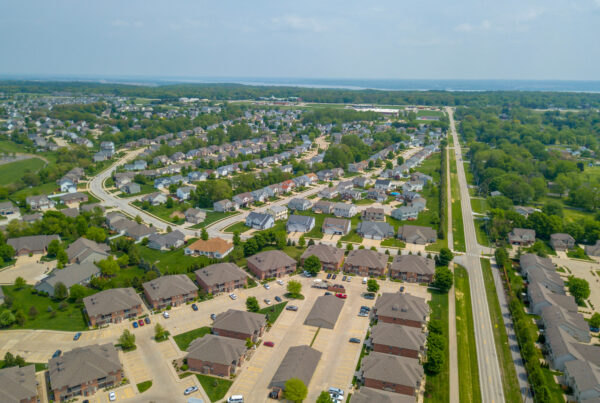
A Massachusetts investor drives forty minutes north on Route 3, crosses the state line into Nashua, and looks at the same kind of duplex she was priced out of in Lowell. The purchase price is lower. The tenant pool is full of Boston commuters who want more space for less rent. And the state she is now standing in does not tax wages the way her home state does. She runs the numbers twice, because the first time they looked too good.
Then she calls her bank and hits the wall every investor eventually hits. The lender wants two years of tax returns, and her returns show heavy write-offs from her consulting business. On paper she looks broke. In her checking account she looks like exactly the kind of borrower who should own six rental properties.
That gap between what your tax return says and what you can actually afford is the entire reason asset-based lending exists. Instead of qualifying you on personal income, these programs qualify you on what the property earns, what your business deposits show, or what you hold in liquid assets. For investors buying in New Hampshire, from Manchester triple-deckers to North Conway ski condos to Winnipesaukee lake cottages, that difference decides whether a deal happens or dies in underwriting.
This guide ranks the best asset-based loan programs for New Hampshire investors, explains how each one fits the state’s unusual mix of commuter rentals and four-season vacation markets, and lists the lenders worth comparing before you commit.
Why New Hampshire Pulls Investors Across the Border
New Hampshire punches above its weight for a small state. Manchester and Nashua sit close enough to the Boston metro that renters commute south daily, which gives southern New Hampshire landlords access to Massachusetts wages at New Hampshire price points. That commuter dynamic keeps demand steady for long-term rentals in a way most small markets cannot match.
Head north and the state changes character completely. The White Mountains draw skiers all winter to Lincoln, Loon, and the North Conway corridor, then swap in hikers, leaf-peepers, and Storyland families the rest of the year. The Lakes Region around Winnipesaukee runs on a summer engine, with Laconia, Meredith, and Wolfeboro filling up from Memorial Day through fall foliage. A well-run short-term rental in either region can earn across all four seasons, though the monthly pattern looks nothing like a steady long-term lease.
Then there is the tax angle. New Hampshire does not levy a state income tax on wages, which many investors treat as one more point in the state’s favor when comparing it to neighbors. Tax rules change and every investor’s situation is different, so confirm how New Hampshire’s tax treatment applies to you with a tax professional before you build it into your projections. But as a qualitative draw, it is real, and it is part of why so many Massachusetts investors look north.
The catch is that vacation condos, seasonal cottages, and self-employed buyers are exactly the scenarios conventional underwriting handles worst. Asset-based programs were built for them.
The Best Asset-Based Loan Programs for New Hampshire Investors, Ranked
Each program below qualifies you on something other than a W-2. The right one depends on what you are buying and how your income actually flows.
1. DSCR Loans: The Workhorse for Rentals from Nashua to North Conway
If you are buying a rental property in New Hampshire, a DSCR loan should be the first program you price. DSCR stands for debt service coverage ratio, and the concept is simple: the lender divides the property’s monthly rent by the full monthly payment, meaning principal, interest, taxes, insurance, and any association dues, often abbreviated PITIA. If a Manchester duplex rents for $2,600 a month and the full payment is $2,200, the DSCR is roughly 1.18, and the property covers itself with room to spare.
What makes DSCR loans powerful is what they leave out. No personal tax returns. No W-2s. No debt-to-income calculation built on your salary. The property qualifies on its own performance, which means a self-employed investor with aggressive write-offs and a salaried engineer look the same to the underwriter as long as the deal pencils.
For long-term rentals in Manchester, Nashua, and Concord, underwriters typically use the lease in place or a market rent estimate from the appraisal. Commuter-market rentals in southern New Hampshire tend to appraise with solid rent support because demand is consistent.
Short-term rentals in the mountains and the Lakes Region are where lender selection matters most. A North Conway ski condo might earn a large share of its annual revenue between December and March, then a second wave in summer and foliage season, with soft shoulders in between. Some DSCR programs only credit long-term market rent, which understates what a four-season STR actually earns. Others accept short-term rental income documented through booking platform history or a market data report, which can be the difference between a deal that qualifies and one that falls short. If you are buying in Lincoln, North Conway, or on Winnipesaukee, ask up front how a program treats STR income, because the answer varies widely.
Specific DSCR thresholds, credit minimums, and maximum leverage are program-dependent and set by each investor’s guidelines. Directionally, a higher coverage ratio, stronger credit, and a larger down payment all improve pricing, and properties that barely break even face tighter terms. Most DSCR loans also carry prepayment penalty options that affect your rate, so think about how long you plan to hold before you pick a structure.
Trade-offs: DSCR pricing runs above conventional owner-occupied financing, and a property with weak rent coverage may need more money down to work. For a pure rental purchase, though, nothing else matches the simplicity.
2. Bank Statement Loans: For the Self-Employed Buyer Heading North
Plenty of New Hampshire deals are not pure rental plays. Maybe you run a business in the Boston area and want to relocate to Bedford or Portsmouth while keeping your company. Maybe you are buying a property you will use part of the year and rent the rest, which pushes you out of DSCR territory. Or maybe you simply want to qualify on your real cash flow instead of a lease.
Bank statement loans qualify you on 12 or 24 months of business or personal bank deposits instead of tax returns. The lender reviews your statements, applies an expense factor appropriate to your business type, and derives a qualifying monthly income from what actually flows through your accounts. For a contractor, agency owner, or consultant whose Schedule C shows a fraction of real earnings, the difference is dramatic.
This program fits the classic border-crossing profile: a self-employed Massachusetts resident whose business is thriving but whose tax return is optimized for deductions, buying a primary or second home in New Hampshire, or picking up an investment property that a DSCR program does not fit. It also suits New Hampshire’s own self-employed base, from trades businesses in the Manchester area to seasonal operators in the tourism corridor whose deposits spike in winter and summer.
Trade-offs: more documentation than DSCR, since the lender reviews a year or two of statements, and the expense factor applied to your deposits varies by program and business type. Larger down payments and reserve expectations are common, and all of it is subject to each lender’s guidelines.
3. Asset Depletion Loans: Qualify on What You Have, Not What You Earn
Some buyers show almost no income at all yet hold substantial assets. Early retirees who sold a Boston-area home or business. Investors living off a brokerage portfolio. Buyers between ventures with a large cash position. Asset depletion, sometimes called asset utilization, converts eligible liquid assets into a qualifying monthly income figure by dividing the balance over a set term defined by the program.
As an illustration only, a borrower with $1.5 million in eligible assets under a program using a 60-month calculation might show $25,000 in qualifying monthly income without a single pay stub. The divisor, which asset types count, and at what percentage all differ by lender, so treat that math as a sketch rather than a promise.
In New Hampshire this program shows up most often around the Lakes Region and the Seacoast, where buyers who have already built wealth purchase a Winnipesaukee waterfront home or a Portsmouth condo without wanting to liquidate investments or document income they no longer draw. It pairs naturally with the state’s appeal to people restructuring their finances later in life; some of those same homeowners eventually look at reverse mortgage options too, which is a separate conversation worth having with a loan expert.
Trade-offs: you need meaningful liquid assets for the math to produce enough income, and retirement accounts are often counted at a discount depending on your age and the program.
4. P&L, 1099, and Bridge Loans: The Situational Tools
Three more programs deserve a quick mention because each solves a specific New Hampshire problem.
P&L statement loans qualify you on a profit and loss statement prepared by a licensed tax professional, useful when even bank statements are messy, such as a business with heavy transfers between accounts. 1099 loans serve independent contractors, from traveling nurses in the Dartmouth-Hitchcock orbit to commissioned salespeople, using 1099 income directly instead of net figures off a tax return.
Bridge and short-term loans matter in New Hampshire’s tighter inventory pockets. When a well-priced ski condo in Lincoln or a dated lake cottage in Laconia hits the market, speed wins. A bridge loan lets you close fast or fund a renovation, then refinance into a long-term DSCR loan once the property is stabilized and rented. Investors renovating tired vacation properties into modern STRs use this two-step constantly.
How to Pick the Right Program for Your New Hampshire Deal
A quick way to sort yourself:
| Your situation | Start with |
| Buying a long-term rental in Manchester, Nashua, or Concord | DSCR loan |
| Buying a ski or lake STR in North Conway, Lincoln, or the Lakes Region | DSCR loan with STR income treatment |
| Self-employed, buying a home or mixed-use property | Bank statement loan |
| High assets, little documented income | Asset depletion |
| Independent contractor paid on 1099s | 1099 loan |
| Fast close or renovation, refinance later | Bridge, then DSCR |
When two programs both fit, price both. This is where working with a broker rather than a single lender pays off, because the same borrower can get meaningfully different terms across programs, and you will not know without comparing.
A Worked Example: Four-Season Math on a North Conway Condo
Here is an illustrative example with round numbers, not market data. An investor finds a two-bedroom condo near North Conway village listed at $400,000 and plans to run it as a short-term rental. Projected booking income averages $4,000 a month across the year, front-loaded in ski season and summer. The full monthly payment, including principal, interest, taxes, insurance, and $350 in association dues, comes to about $3,200.
Dividing $4,000 by $3,200 gives a DSCR of 1.25. On a program that accepts documented STR income, that ratio supports approval on the property’s earnings alone. On a program that only credits long-term market rent, the same condo might show $2,300 in monthly rent and a ratio below 1.0, which changes the required down payment or kills the deal. Same condo, same buyer, very different outcomes. The lesson for mountain and lake purchases is to match the program to the income pattern before you write the offer.
Best Asset-Based Lenders Serving New Hampshire Investors
Program fit matters more than logo, but here are the companies investors most often compare for New Hampshire deals.
1. Select Home Loans
Select Home Loans is a nationwide investor-loan broker specializing in Non-QM financing: DSCR loans, bank statement loans, asset depletion, P&L loans, and bridge options. Rather than boxing you into one guideline set, Select shops a single application across a network of wholesale lenders and investors, which is especially valuable for New Hampshire scenarios that need the right fit, like STR income on a ski condo or seasonal deposits from a tourism business. That comparison-first model is the whole point of using a broker. Reach Nick at (888) 550-3296 or selecthomeloans.com to see which programs match your deal.
2. Deephaven Mortgage
Deephaven is one of the longer-standing names in Non-QM lending, with a wide menu that includes DSCR, bank statement, and asset utilization programs. It works primarily through brokers and correspondents and is known for guideline depth across borrower types.
3. A&D Mortgage
A&D Mortgage offers a broad Non-QM lineup spanning DSCR, bank statement, and other alternative documentation products. It is known for a wide product shelf and technology aimed at faster processing on non-traditional files.
4. Truss Financial Group
Truss focuses heavily on self-employed borrowers, with bank statement and stated-style programs at the center of its offering. Business owners with complex returns often land on its radar when a conventional lender says no.
5. RCN Capital
RCN Capital is a national private lender centered on investor products, including short-term bridge and fix-and-flip financing alongside long-term rental loans. It fits investors running the renovate-then-refinance play on dated vacation properties.
6. Griffin Funding
Griffin Funding offers a range of Non-QM products including DSCR, bank statement, and asset-based options, and is known for working with investors and self-employed borrowers across many states.
This list reflects the author’s opinion and is presented in no particular order beyond that preference. Programs, terms, and state availability differ by company, so compare options against your own situation before choosing.
Qualifying and Closing: What the Process Looks Like
Every program above is subject to investor guidelines that change, so treat the following as direction rather than fixed rules. Credit still matters even without tax returns; stronger scores open higher leverage and better pricing across all of these programs. Down payments on investment properties run higher than owner-occupied loans, and reserve requirements, meaning months of payments in liquid funds after closing, are common and program-dependent. Condos, including the ski developments around Lincoln and North Conway, add a condo review step where association budgets, insurance, and rental policies get examined.
The process itself runs in familiar stages: a scenario conversation and pre-qualification, application and documentation suited to your program, appraisal with rent or STR income analysis, underwriting, and closing. Timelines vary by transaction, property type, and how quickly documentation comes together, so ask your loan expert for a realistic estimate on your specific deal. Investors buying from out of state can typically complete the entire process remotely, which matters since so many New Hampshire buyers live in Massachusetts.
Frequently Asked Questions
Can I use projected Airbnb income to qualify for a ski condo in North Conway or Lincoln?
Some DSCR programs accept short-term rental income documented through booking history or third-party market data, while others only credit long-term market rent. Program selection decides the answer, so raise it before you apply.
How do HOA dues on ski-town condos affect a DSCR loan?
Association dues count inside PITIA, the full payment used in the DSCR calculation. High dues, common in amenity-heavy ski developments, push the ratio down, so a condo with $500 monthly dues needs more rent to hit the same coverage as one with $150.
What about lakefront properties that only rent well in summer?
Underwriters look at annualized income, so a Winnipesaukee cottage earning most of its revenue from June through October can still qualify if the yearly average covers the payment. Seasonal insurance, winterization status, and year-round access can also affect eligibility, so flag these details early.
Do these loans work for Manchester or Nashua multifamily buildings?
Yes. Two- to four-unit buildings are standard DSCR territory, and some programs extend to larger residential properties. Commuter-market rent demand tends to support solid appraised rents in southern New Hampshire.
Can I buy a New Hampshire rental while living in Massachusetts?
Yes, and it is one of the most common scenarios in the state. You do not need to live in New Hampshire to finance an investment property there, and remote closings are routine. Confirm program availability for your situation with your loan expert.
Will New Hampshire’s lack of a wage income tax help me qualify?
Qualification for these programs rests on property income, deposits, or assets rather than your tax bill, so the tax picture does not change underwriting. It can affect your overall returns as an investor, but tax rules change and apply differently to residents and non-residents, so talk to a tax professional.
Do DSCR loans require an LLC?
Most programs allow closing in an LLC and many investors prefer it, but personal-name closings are usually available too. Entity requirements and guarantees vary by program.
What if my property’s rent does not fully cover the payment?
Some programs allow ratios below break-even with compensating factors like a larger down payment or stronger credit. Terms tighten as coverage drops, and every threshold is program-dependent.
Can I refinance a bridge loan into a DSCR loan after renovating?
That is the standard playbook. Once the property is renovated and rented, a DSCR refinance can pay off the bridge loan and lock in long-term financing based on the new rent. Seasoning requirements before using the new appraised value vary by program.
Are second homes eligible, or only pure rentals?
DSCR loans are for investment properties, but bank statement and asset depletion programs can finance second homes. If you want personal use of a lake or ski property plus some rental income, discuss occupancy classification with your loan expert, because it drives which programs apply.
How much do prepayment penalties matter on these loans?
DSCR loans commonly offer prepayment penalty options that trade a lower rate for a commitment period. If you plan to sell or refinance quickly, a shorter or no-penalty structure may cost more monthly but save you at exit. Structures vary by lender.
Is a large down payment enough to offset weaker credit?
More equity helps, and some programs weigh it heavily, but credit still influences approval and pricing on nearly every asset-based product. Where the balance lands is specific to each program’s guidelines.
The Bottom Line for New Hampshire Investors
New Hampshire offers a rare two-in-one market: steady Boston-commuter rentals in Manchester and Nashua on one end, and four-season vacation income in the White Mountains and Lakes Region on the other. Asset-based loans are what make both accessible to real-world investors, the self-employed buyer whose tax returns undersell her, the out-of-state landlord scaling a portfolio, the retiree qualifying on assets instead of a paycheck. DSCR loans carry most rental purchases, bank statement loans serve the self-employed, and asset depletion, P&L, 1099, and bridge programs fill the gaps.
One caution as you plan: programs, guidelines, and requirements in the Non-QM space change over time and differ across lenders. Verify current guidelines with a loan expert before making decisions based on anything you read here.
If you are weighing a Nashua duplex, a North Conway ski condo, or a Winnipesaukee cottage, the fastest way forward is a scenario conversation. Call Nick at (888) 550-3296 or visit Select Home Loans, NMLS #2384002 | Email: info@selecthomeloans.com, to compare loan options and get pre-approved for your next New Hampshire investment.