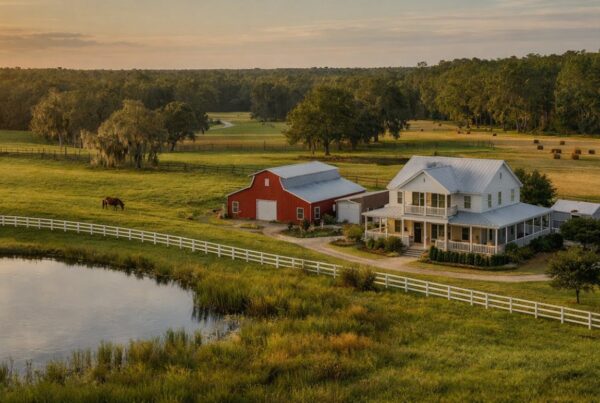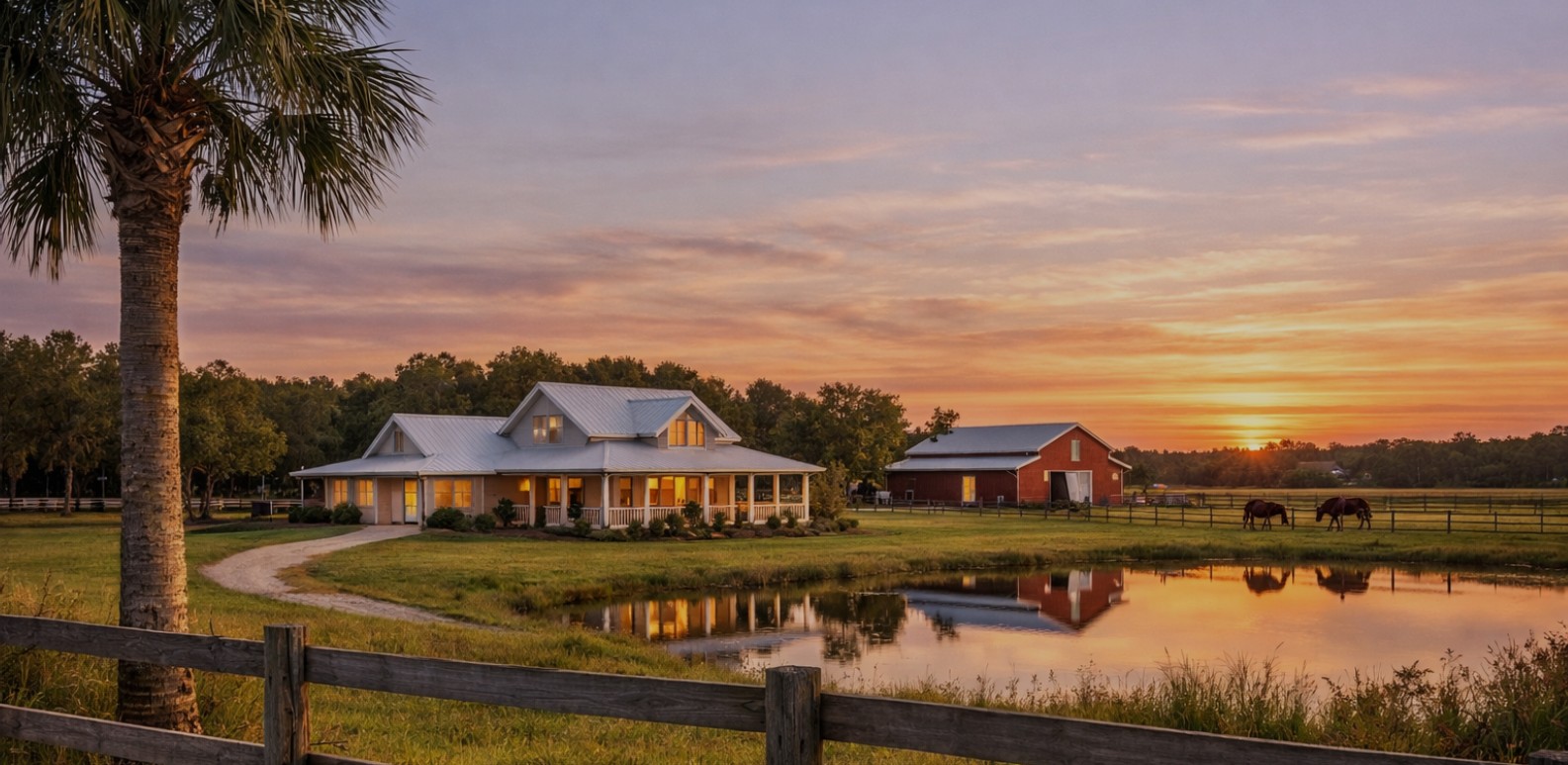

You found the perfect rental. A solid three bedroom house, a detached garage, a barn in decent shape, and twelve acres of pasture and woods. The rent numbers work. Your credit is fine. Then the lender calls back and says the deal is dead because the property sits on too much land.
This happens to real estate investors every week. Most DSCR lenders cap acreage somewhere between two and ten acres, and the exact cutoff varies from program to program. Cross that line and the file gets declined, no matter how strong the borrower or how profitable the rental. Investors in rural and exurban markets, where a ten or fifteen acre parcel is completely normal, end up locked out of the very loan product built for them.
The good news is that DSCR loan acreage limits are not universal. Some programs will finance income producing residential rentals on parcels up to 20 acres, and a broker who works with a wide lender network can usually find them. The catch is that these deals get underwritten differently. The appraisal is more complicated, the land to value ratio matters, and the property has to be a true residential rental rather than a farm with a house on it.
This guide walks through all of it: why lenders cap acreage in the first place, what changes when the parcel gets big, how DSCR qualification works on a rural rental with a worked example, what appraisers look for on properties with wells, septic systems, and private roads, and the mistakes that sink these loans before closing.
Why Most DSCR Lenders Cap Acreage
Acreage limits are not arbitrary. They exist because large parcels create three specific problems for the lender, and understanding those problems tells you exactly what an underwriter needs to see before approving a large lot investment property loan.
Comparable sales are scarce
A DSCR lender’s security is the property itself, so the appraised value has to be defensible. In a subdivision, an appraiser can pull five recent sales of nearly identical homes within a mile. On a 15 acre parcel outside a small town, the nearest comparable sale might be eight miles away, six months old, and sitting on 40 acres. The wider the appraiser has to search, the more adjustments the report needs and the less confident the lender feels in the number.
Marketability risk
If the loan defaults, the lender has to sell the property. Homes on large parcels take longer to sell than homes on standard lots because the buyer pool is smaller. Fewer buyers want to maintain 18 acres, and fewer still can finance it. Lenders price and limit that risk, and the bluntest tool for doing so is an acreage cap.
Agricultural use risk
This is the big one. DSCR loans are residential investment loans. They are built for properties where the income comes from someone paying rent to live in a dwelling. The moment the land itself starts producing income, through row crops, livestock, timber, or a commercial boarding operation, the property starts looking like a farm. Farms are commercial agricultural assets, they are valued differently, they are foreclosed differently under state law in some jurisdictions, and no DSCR program wants them. Larger parcels raise the odds that agricultural use is happening or could happen, so lenders draw a line.
The programs that go up to 20 acres have not eliminated these risks. They have decided the risks are manageable when the property clearly remains residential. That word, residential, drives everything that follows.
The Core Rule: The House Carries the Deal, Not the Land
Before we get into underwriting mechanics, one point needs to be completely clear, because it decides whether your deal is financeable at all.
A DSCR loan on acreage finances an income producing residential rental that happens to sit on a large parcel. It does not finance land. Raw land alone does not qualify for DSCR financing, period. There must be a habitable dwelling generating rental income, and the value of the property should sit primarily in that dwelling and its residential improvements rather than in the land or in any farm operation.
Underwriters look at this through what is often called the land to value ratio: the share of the total appraised value attributable to the land. Every lender treats it a little differently, and there is no single universal cutoff, but the pattern is consistent. When most of the value is in the house, the deal reads as residential. When most of the value is in the dirt, the deal reads as a land play with a house on it, and lenders back away because a fire could destroy the dwelling and leave them secured mostly by vacant land, which is exactly the asset class they refused to finance in the first place.
Practical takeaway: a $400,000 property where the home contributes $300,000 of value is a much easier file than a $400,000 property where the home contributes $150,000, even if the acreage is identical.
What Changes in Underwriting on a Big Parcel
Once you cross a few acres, several parts of the file get more scrutiny than they would on a quarter acre suburban rental.
Appraisal complexity
Expect the appraisal to take longer and cost more. The appraiser has to search a wider radius and a longer time window for comparable sales, then make site size adjustments to bridge the gap between, say, a comp on five acres and your subject on sixteen. Good appraisers in rural markets do this routinely, but the report needs to hold together, and lenders read these appraisals closely. If your area has a few recent sales of homes on similar acreage, the file gets easier. If nothing comparable has sold in two years, expect questions.
Outbuildings and how they are treated
Barns, workshops, pole buildings, and detached garages are common on acreage, and they are handled carefully. Residential outbuildings that support normal property use typically receive modest contributory value in the appraisal. What they cannot do is dominate the valuation or signal commercial use. A 1,600 square foot house next to a 12,000 square foot commercial grade barn with livestock stalls and a loading area tells the underwriter this is an agricultural facility. Smaller, ordinary outbuildings rarely cause trouble. Large specialized ones can.
No agricultural income in the picture
The rental income that qualifies the loan must come from the dwelling. Lease revenue from farming the land, grazing rights, hunting leases, or timber cannot be used to qualify, and if agriculture is the property’s primary use, the deal will not fit a DSCR program at all. Some lenders tolerate incidental hobby use, such as a tenant keeping a couple of horses. Active commercial farming is a different animal entirely.
Zoning and highest and best use
The appraiser must conclude that residential use is the highest and best use of the property. Agricultural zoning is not automatically fatal, since plenty of rural residential parcels carry ag zoning, but the appraisal needs to support residential use, and the county’s treatment of the parcel matters. More on the tax exemption trap later, because it catches a lot of buyers.
How DSCR Qualification Works on a Rural Rental
The mechanics of a rural DSCR loan are the same as any DSCR loan. The lender divides the property’s monthly rent by the monthly payment, which includes principal, interest, taxes, insurance, and any association dues. A ratio at or above the program’s minimum, often set around the point where rent covers the full payment, qualifies the property. Your personal income, tax returns, and employment are not part of the calculation, which is exactly why self employed investors and buyers with complicated tax situations gravitate to this product. If your income documentation is the obstacle rather than the property, related tools like bank statement loans and P&L loans solve a similar problem on the owner occupied side.
A worked example
The numbers below are round, illustrative figures, not market data.
Say you are buying a three bedroom home on 14 acres in an exurban county for $450,000. You put 25 percent down and finance $337,500. Suppose the full monthly payment, including taxes and insurance, comes to $2,800. An appraiser’s market rent analysis supports $3,200 per month for the home as a long term rental.
Divide $3,200 by $2,800 and you get a DSCR of about 1.14. The property covers its own payment with margin to spare, and the deal qualifies on the strength of the rental income alone. Nobody asked for a tax return.
Now flip one variable. If thin rent comps push the supported market rent down to $2,500, the ratio drops to roughly 0.89 and the deal no longer covers itself. Some programs will still consider sub 1.0 ratios with a larger down payment or other compensating factors, but the pricing and terms change. On acreage deals, the rent number is where files live or die, which brings us to the next section.
Market rent when comps are thin
On a suburban rental, the appraiser fills out a rent schedule using nearby leased homes. In a rural market there may be very few documented leases of comparable homes on comparable land. Appraisers handle this by widening the search area, adjusting from smaller parcel rentals, and looking at the practical reality that tenants pay for the house and a bit of privacy, not for acreage they will never use. That last point matters for your own projections: rent on a home with 15 acres is usually only modestly higher than rent on the same home with two acres. Investors who assume the land multiplies the rent get burned.
If you are running a short term rental, know that many DSCR programs qualify STRs using the appraiser’s long term market rent figure, while others will consider documented short term revenue, often with a history requirement or a haircut applied. Which approach a lender takes can swing your qualification dramatically, so sort this out before you write an offer.
Property Types That Fit, and Ones That Get Complicated
The cleanest candidates for a DSCR loan for property with land share a profile: a conventional, habitable dwelling that is clearly the main event on the parcel.
Good fits include single family homes on acreage rented long term, cabins and lodges operating as short term rentals in vacation markets, and small homestead style properties where the house is leased to a long term tenant and the land is incidental. The rural STR category deserves special mention. Cabin markets near national parks, lakes, and mountain towns have grown up around exactly this property type, and remote work has pushed both travelers and full time tenants further from metro cores. A well located cabin on eight wooded acres can be a strong DSCR candidate because the acreage is part of the guest experience rather than a farming asset.
Program dependent property types include manufactured homes, log construction, barndominiums, geodesic domes, and other unique builds. Some lenders finance them on acreage, many do not, and appraising a one of a kind home on a large parcel compounds the comparable sales problem. If your target property fits this description, get lender feedback before you spend money on inspections.
Poor fits include working farms and ranches, properties where a commercial operation runs from the outbuildings, parcels where most of the value is land, and anything without a habitable dwelling.
Wells, Septic Systems, and Private Roads
Rural properties usually run on private infrastructure, and appraisals on acreage flag items that never come up in town.
Private wells and septic systems are normal and financeable, but lenders may require water testing or septic inspections depending on the program and what the appraisal notes. Budget time for this. Private road access raises two questions: is there legal access, meaning a deeded easement or recorded right of way rather than a handshake, and is there a road maintenance arrangement? Missing or informal easements are among the most common late stage surprises on rural files, and a title company can usually confirm access early if you ask. Properties served by off grid power or unusual utility setups get extra scrutiny and are, again, program dependent.
None of these items should scare you off. They are routine in rural lending. They just need to be identified in week one instead of week five.
LTV, Credit, and Reserves on Acreage Deals
Terms on large lot files tend to run slightly more conservative than on standard DSCR loans, and everything below varies by lender, so treat these as ranges rather than promises.
| Factor | Typical shape on acreage deals |
| Maximum LTV | Often somewhat lower than standard DSCR caps; larger parcels may step down further |
| Credit score | Minimums vary by program; stronger scores earn better pricing and higher leverage |
| Reserves | Commonly several months of payments; remote properties or STRs may require more |
| DSCR minimum | Program dependent; below 1.0 sometimes allowed with compensating factors |
| Acreage cap | Ranges from around 2 up to 20 acres depending on the program |
| Prepayment penalty | Common on DSCR loans, with buyout options at many lenders |
Plan on a meaningful down payment, usually in the range of 20 to 30 percent depending on the program, the DSCR, and the parcel, and confirm the current numbers with your broker because guidelines shift over time.
Purchase and Cash-Out Refinance Uses
Purchases are the obvious use, but cash out refinancing may be the more underused one. Plenty of investors own rural rentals free and clear or with small balances, often inherited property or homes bought cheaply years ago. Exurban migration has pushed values up in many of these markets, and a DSCR cash out refinance lets an owner pull equity out based on the rental income, without tax returns, and redeploy it into the next acquisition. Rate and term refinancing also works for owners stuck in hard money or seller financing who want a long term fixed loan. If you hold substantial equity but do not want to touch your first mortgage, a HELOC or second mortgage can serve a similar purpose on other properties in your portfolio.
Exit Strategy Thinking for Rural STR Investors
Underwrite your exit before you buy. A cabin on acreage in a strong vacation market can produce excellent short term rental revenue, but STR income is seasonal, regulation can change, and the resale buyer pool for a remote 18 acre property is thin. Ask three questions before closing. First, does the property work as a long term rental if STR rules tighten? Run the DSCR on long term market rent, not just projected nightly revenue. Second, who buys this property from you in seven years, and can they finance it? A parcel that is hard to finance is hard to sell. Third, are you near an established market with a track record, or are you pioneering? Pioneering can pay, but it deserves a bigger cushion in your numbers.
Mistakes to Avoid
The agricultural exemption trap sits at the top of the list. In many counties, land enrolled in an agricultural tax program carries dramatically lower property taxes, and listings advertise it as a perk. Buying a property under an active ag exemption without checking the lending impact can wreck your financing two ways. The classification signals agricultural use, which conflicts with the residential character a DSCR lender requires, and removing the exemption can trigger rollback taxes, sometimes several years of back taxes plus interest, along with a permanent jump in your annual tax bill that drags your DSCR down. Ask about the parcel’s tax status on day one.
Overestimating rural rents is the second big one. Investors see 15 acres and price the rental like an estate. Tenants see a house with a long driveway. Get a rent opinion from a local property manager before you write the offer, and build your DSCR on that number rather than on hope.
Other repeat offenders: skipping the easement check on private road access, falling for a unique build without confirming a lender will touch it, ignoring how much the well and septic timeline can stretch a closing, and letting a seller’s oversized commercial barn tank the residential character of the appraisal.
Pros and Cons of DSCR Loans on Acreage
On the plus side, you qualify on the property’s rent rather than your personal income, which suits self employed buyers and investors with heavy write offs. You can buy property types and parcel sizes that many lenders refuse. You can close in an LLC on most programs, scale beyond conventional loan count limits, and pull cash out of rural equity that would otherwise sit idle.
On the minus side, expect somewhat higher rates than owner occupied conventional financing, larger down payments, prepayment penalties on many programs, more demanding appraisals with longer timelines, and a smaller pool of lenders, which makes broker access to multiple programs matter more than it does on a standard deal.
Frequently Asked Questions
Can I get a DSCR loan on 20 acres?
Yes, through the subset of programs that allow it. Most DSCR lenders cap out well below 20 acres, so the search is really about finding the right program, which is where a broker with a wide lender network earns their keep.
Does raw land qualify for a DSCR loan?
No. DSCR financing requires an income producing residential dwelling. Vacant land, even beautifully located vacant land, needs a land loan or construction financing instead.
Will the appraiser value all 20 acres?
The appraiser values the whole property, but a few programs value or lend against only a capped portion of the acreage, with the excess contributing little or nothing to the lending value. Ask how your specific program handles it before you count on the land in your equity math.
Can the property have a barn or workshop?
Usually, yes. Ordinary residential outbuildings are fine and add modest value. Very large or commercial grade structures can push the property out of residential territory, so flag them to your broker early.
What if the property currently has an agricultural tax exemption?
It is not automatically a dealbreaker, but it must be addressed. Some transactions require removing the exemption, which can trigger rollback taxes and raise the ongoing tax bill. Get the county’s rules and the lender’s position in writing before you commit.
Can I use Airbnb income to qualify a cabin on acreage?
Some programs accept documented short term rental revenue, often with a history requirement or a discount. Others use the appraiser’s long term market rent regardless of how you operate. Confirm the method before you underwrite the deal for yourself.
Do DSCR lenders finance manufactured homes on large parcels?
A limited number do, subject to conditions such as permanent foundations and title status. Combining a manufactured home with high acreage narrows the field further, so verify program fit first.
How do lenders treat a property with two homes on one parcel?
A house plus a second dwelling or ADU can work on some programs, and rental income from both units may count. The configuration has to appraise as residential, and lender treatment varies widely.
Is a DSCR loan closing slower on rural property?
Often, yes. Appraiser availability in rural counties, well and septic testing, and easement verification can add days or weeks. Starting those items immediately after contract keeps the timeline reasonable.
Can I close in an LLC?
Most DSCR programs allow, and many investors prefer, closing in an LLC or other entity. Expect a personal guarantee from the members in most cases.
What happens if my DSCR comes in below 1.0?
Some programs allow ratios below break even with compensating factors such as a lower LTV or stronger reserves, at adjusted pricing. Others require the ratio to clear their minimum with no exceptions. Your broker can match the scenario to the right program.
Can I do a cash-out refinance on a rural rental I own free and clear?
Yes, and it is one of the most common uses of these programs. The property qualifies on its rent, and seasoning requirements on recently purchased properties vary by lender.
Do hunting leases or grazing income count toward the DSCR?
No. Only rental income from the dwelling counts, and significant land based income can raise agricultural use concerns that hurt the file rather than help it.
The Bottom Line on DSCR Loan Acreage Limits
Acreage caps knock more rural investment deals out of financing than credit or income ever will, and most investors never learn that the cap that killed their deal was one lender’s rule, not an industry law. Programs financing residential rentals on up to 20 acres exist. They demand a property where the house carries the value, rents that survive an appraiser’s scrutiny, clean legal access, and no agricultural entanglements. Bring that file to the right lender and a 14 acre cabin rental closes much like any other DSCR deal.
Programs, acreage limits, LTV caps, and reserve requirements change over time and differ from lender to lender, so verify current guidelines with a loan expert before making offers.
If you are looking at a rental on a larger parcel and want to know whether it fits, talk it through with someone who places these loans every week. Call Nick at (888) 550-3296 or visit Select Home Loans to compare loan options and request a rate quote. NMLS #2384002 | Email: info@selecthomeloans.com. A ten minute conversation about the parcel, the dwelling, and the rents will tell you exactly where you stand.