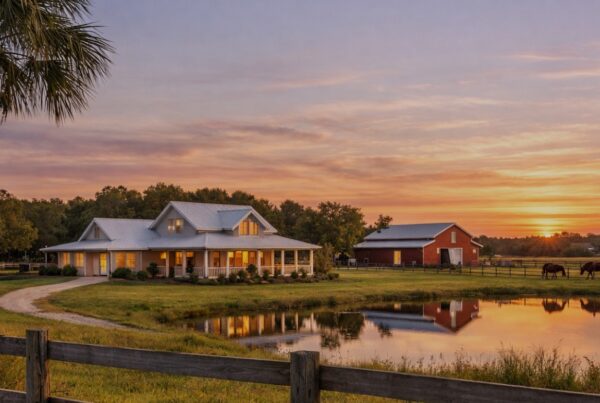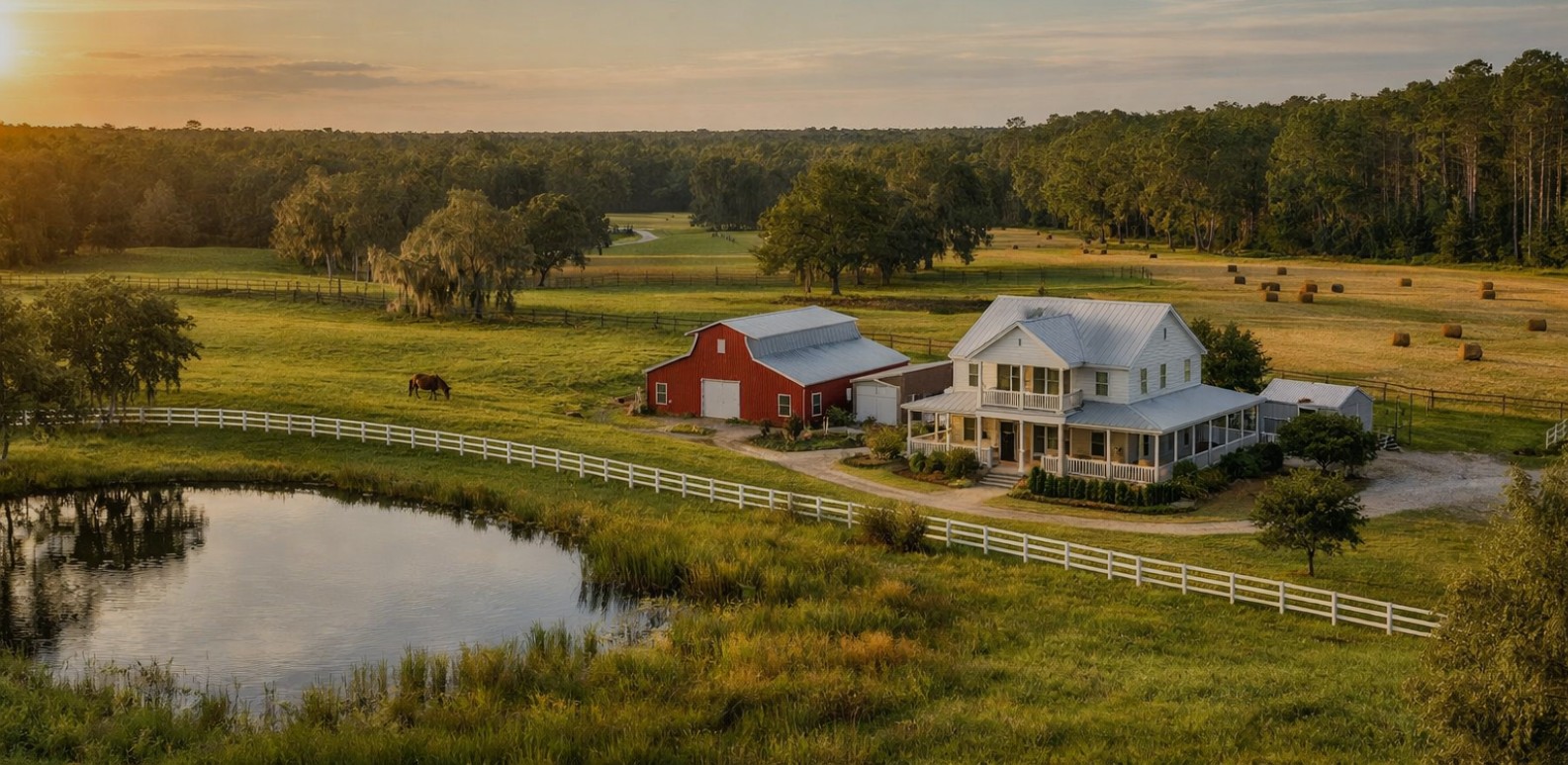

You found a rental property an hour outside Ocala. Solid three bedroom house, fenced pasture, a pole barn, and 15 acres of high ground. The numbers work, the rent covers the payment with room to spare, and you have the down payment ready. Then the lender calls back. The property sits on too much land. Their DSCR program caps out at 10 acres, and some cap at 2 or 5. The deal dies before an appraiser ever sets foot on the driveway.
This happens constantly in Florida. Investors who want rural rentals, equestrian properties near Ocala, or large-lot homes in the fast-growing counties north of Orlando keep running into acreage limits that have nothing to do with how good the deal is. Most DSCR lenders simply were not built for properties bigger than a subdivision lot.
The good news is that some DSCR programs, including options Select Home Loans brokers, allow residential investment properties on up to 20 acres. That opens up a whole category of Florida rentals that most investors assume cannot be financed without a local bank or a commercial loan.
One thing needs to be clear up front, because the word “land” trips people up. A DSCR loan on acreage is still a loan on an income-producing residential property. There has to be a livable home on the parcel, the loan qualifies on the rental income that home produces, and the value needs to sit primarily in the residence rather than in the dirt or a farming operation. Raw land with no dwelling generally cannot be financed with a DSCR loan at all. When we talk about DSCR loans for Florida land, we mean large-lot residential investment property, not vacant acreage.
This article walks through why acreage caps exist, what underwriters actually look at on big parcels, how the DSCR calculation works on rural rentals, and where Florida-specific issues like agricultural classification and flood zones come into play.
Why Most DSCR Lenders Cap Acreage in the First Place
Acreage limits are not arbitrary. They exist because large parcels create three problems for lenders, and understanding those problems helps you pick properties that will actually get approved.
The appraisal comparable problem
A DSCR lender leans heavily on the appraisal, since the loan is underwritten on the property rather than your personal income. Appraisers value a home by comparing it to recent sales of similar properties. In a subdivision, that is easy. On 18 acres outside Chiefland or Bonifay, the appraiser may have to search a wide radius and go back many months to find sales of homes on comparable acreage. Thin comparable data makes lenders nervous, so many of them just draw a line at 2, 5, or 10 acres and decline everything above it.
Marketability concerns
If a lender ever has to take a property back and sell it, a typical suburban rental moves quickly. A home on 20 acres appeals to a smaller pool of buyers, and it can sit on the market longer. Lenders price and structure around that risk, and the more conservative ones avoid it entirely.
The agricultural-use question
This is the big one. Residential mortgage programs, including DSCR loans, are designed for housing, not farms. When a parcel gets large, underwriters start asking whether the property is really a residence with land around it, or a working agricultural operation with a house attached. Row crops, commercial livestock, a licensed nursery, or leased farmland can push a property out of residential lending territory altogether. Programs that go up to 20 acres still require the property to be residential in nature. The acreage can include pasture, woods, and trails, but the primary use and the primary value have to be the home.
What Underwriters Look at on Large Florida Parcels
When you submit a DSCR loan on acreage in Florida, the file gets a closer look than a standard rental would. Here is what actually gets examined.
Where the value sits
Underwriters want the residence, not the land, to carry most of the appraised value. If a property appraises at $600,000 and the appraiser attributes $450,000 of that to the land, the file has a problem. There is no universal percentage that every program uses, and the thresholds vary by lender, but the principle is consistent. A modest mobile home on 20 premium acres of Marion County horse country will struggle. A substantial house on land that supports rather than dominates the value tends to work.
Comparable sales with similar acreage
The appraiser needs to find sales of homes on comparable lot sizes. In areas like Ocala, Dade City, or the acreage corridors around Lakeland, large-lot sales happen often enough that this is usually manageable. In very remote stretches of the Panhandle or the Big Bend, comps can get thin. Before you go under contract, it is worth checking whether homes on similar acreage have sold nearby in the past year. If you cannot find any, the appraiser probably cannot either.
Agricultural income as the primary use
A few fruit trees, a garden, chickens, or a couple of horses for personal enjoyment generally do not turn a property agricultural. A commercial hay operation, leased grazing rights that generate meaningful income, or a boarding facility running as a business can. Underwriters look at listing descriptions, aerial photos, and the appraisal itself. If the property is marketed as a farm, expect questions.
Outbuildings
Barns, workshops, pole buildings, and run-in sheds are common on Florida acreage and they are usually fine. The appraiser will note them and may give them some contributory value, though often less than owners expect. Problems arise when an outbuilding suggests commercial use, like a large commercial greenhouse complex or processing facility. A standard barn or equipment shed on an equestrian-style property near Ocala is normal and expected.
Access, utilities, and condition
Underwriters also confirm the basics. Legal access to a maintained road, functioning utilities, and a home in habitable rentable condition. A long private drive is fine. A property you can only reach by easement across a neighbor’s pasture needs documentation showing that easement is recorded and permanent.
How the DSCR Calculation Works on Rural Rentals
DSCR stands for debt service coverage ratio. The math is simple: the property’s monthly rent divided by the full monthly payment, meaning principal, interest, taxes, insurance, and any association dues. A ratio of 1.0 means rent exactly covers the payment. Above 1.0, the property carries itself. Many programs allow ratios below 1.0 with compensating factors, though terms improve as the ratio climbs.
There is no tax return review, no employment verification, and no debt-to-income calculation. For self-employed investors and anyone whose tax returns understate real income, that structure is the entire appeal. Select Home Loans also brokers bank statement loans and P&L loans for situations where a different documentation approach fits better, but for pure rental property deals, DSCR is usually the cleanest path.
The rent comp challenge in rural areas
On a rural property, the tricky part is establishing market rent. The appraiser completes a rent schedule using comparable rentals, and in rural Florida those comps can be sparse. Fewer homes on acreage are rented, and the ones that are may not show up in easily searchable data.
A few things help. If the property already has a tenant, a signed lease at a market-supportable rate gives the appraiser a concrete anchor. If it is vacant, gather whatever rental listings you can find for homes on land in the general area before you write the offer. And be conservative in your own analysis. Acreage rentals often command a premium over similar houses on small lots, especially near Ocala where equestrian tenants pay real money for fenced pasture and barn access, but the appraiser can only use what the data supports.
Rural demand is stronger than most lenders assume
Here is the part national lenders miss about Florida. Demand for rental homes on land has grown well beyond the traditional farm tenant. Remote workers who relocated to Florida want space and privacy within striking distance of a metro. Families priced out of Orlando and Tampa push outward into Lake, Sumter, Polk, and Marion counties. Equestrian renters around Ocala, which calls itself the horse capital of the world, actively seek homes with pasture and will sign longer leases to keep them. In the Panhandle, growth around Panama City and the inland communities behind the coast has pulled renters into areas that were sleepy a decade ago.
That demand is exactly why large-lot rentals can be strong investments, and exactly why a 10 acre cap is so frustrating.
Property Types That Work, and the Gray Areas
Single family homes on acreage
This is the core use case and the easiest approval. A conventional site-built house on 5 to 20 acres, rented to a long-term tenant, with the value concentrated in the residence. Most large-lot DSCR files in Florida look like this.
Equestrian-style properties
A home with fenced pasture, a barn, and horse improvements can absolutely work, particularly around Ocala and Marion County where such properties are the local norm and comps exist. The line to watch is commercial operation. A house where the tenant keeps personal horses is residential. A 30-stall boarding and training facility is a business, and that usually needs commercial financing instead.
Barndominiums and unconventional builds
Barndominium-style homes, metal building homes, and similar builds are program-dependent. Some DSCR lenders will consider them if the appraiser can find comparable sales of similar structures, which is more feasible in North Florida than it used to be. Others decline them outright. If you are looking at anything unconventional, raise it with your broker on day one rather than after you have paid for an appraisal. This is one of the areas where working with a broker who can shop multiple lenders matters most.
Hobby farms
A property with a garden, a few animals, and some outbuildings sits in a gray area. The deciding factors are usually whether agriculture produces meaningful income, how the property is marketed, and where the appraiser says the value sits. Many hobby-farm style properties close without issue. Some need repositioning, or a different loan, or a conversation before the offer is written.
The Florida Agricultural Classification Caution
Florida offers an agricultural classification, often called greenbelt, that can significantly reduce property taxes on land used for bona fide agricultural purposes. Plenty of large parcels in Marion, Levy, Alachua, Suwannee, and the Panhandle counties carry it.
For a residential DSCR loan, an ag classification on the parcel can complicate things. It signals to the underwriter that at least part of the property is being used agriculturally, and it raises questions about how taxes will be assessed going forward if the use changes. Some lenders will work through it, especially when the classification covers only a portion of the acreage and the home clearly dominates the value. Others treat it as a red flag.
The rules around Florida’s greenbelt classification involve legal and tax specifics that vary by county and situation, so do not rely on general statements, including this one. If a property you are considering carries an agricultural classification, flag it early, confirm the details with the county property appraiser, and let your loan broker run the scenario past lenders before you commit.
Wells, Septic, Flood Zones, and Other Rural Infrastructure
Most Florida acreage properties are on private well and septic rather than municipal utilities. That is completely normal for these loans. The appraiser will note the systems, and depending on the program, the lender may want confirmation that both are functioning. On older properties, a septic inspection is cheap insurance regardless of what the lender requires, because a failed drain field is an expensive surprise on a rental.
Flood zones deserve real attention on rural Florida parcels. Large properties near rivers, in the low-lying stretches of North Florida, or across the flatwoods can have portions in a mapped flood zone even when the house sits high. What matters for lending is usually the dwelling itself. If the home is in a special flood hazard area, flood insurance will be required, and that premium goes straight into your DSCR math since insurance is part of the monthly payment. A property that pencils at a 1.15 ratio without flood insurance may drop below 1.0 with it. Pull the flood map before you write the offer, not after.
Also check road access during wet season. Some rural roads in the Big Bend and Panhandle flood or wash out, and an appraiser will comment on access issues.
LTV, Credit, Reserves, and Cash-Out on Large-Lot Rentals
Loan-to-value limits, credit score minimums, and reserve requirements on large-acreage DSCR loans vary by lender and change over time, so treat everything here as directional and confirm current terms before you plan a deal.
As a general pattern, expect somewhat more conservative terms than a standard DSCR loan on a suburban rental. That can mean a larger down payment or more equity, a modestly higher credit score expectation, and several months of payment reserves in the bank. Stronger DSCR ratios, lower leverage, and clean credit all pull terms back in your favor. Interest rates on DSCR loans generally run above conventional owner-occupied rates, and unique collateral like a 20 acre parcel can price a bit higher still. Your broker can show you where current pricing sits.
Cash-out refinancing is available on large-lot rentals through some programs, and it is a useful tool. Plenty of Florida investors own rural properties free and clear, or bought years ago before land values in Marion, Polk, and the counties north of Orlando climbed. A DSCR cash-out lets you pull equity based on the property’s rental income, without tax returns, and redeploy it into the next acquisition. Maximum LTV on cash-out is typically lower than on a purchase, and the acreage makes lender selection matter even more. A HELOC or second mortgage on the property may also be worth comparing if you want to leave a low-rate first mortgage in place.
Example Scenario
Here is an illustrative example with round numbers, not market data. An investor finds a four bedroom home on 16 acres between Ocala and Gainesville listed at $500,000. Comparable acreage rentals support rent around $3,200 per month. With 25 percent down, the full monthly payment including taxes and insurance comes to about $2,850. That is a DSCR of roughly 1.12, which many programs can work with. Because the parcel exceeds 10 acres, most national DSCR lenders decline it automatically. A broker with access to 20 acre programs places the loan, the appraisal confirms the value sits primarily in the residence, and the deal closes in about four weeks.
Pros and Cons of DSCR Loans on Florida Acreage
| Pros | Cons |
| Finances rural rentals most DSCR lenders decline | Fewer lenders, so terms vary more |
| No tax returns or personal income verification | Appraisals take longer and cost more on acreage |
| Qualifies on rental income, ideal for self-employed investors | Rent comps can be thin in remote areas |
| Works for purchase and cash-out refinance | Ag use or ag classification can complicate approval |
| Close in an LLC on most programs | Typically more conservative LTV than small-lot rentals |
| Taps strong Florida demand for homes on land | Flood insurance can squeeze the DSCR ratio |
Frequently Asked Questions
Can I use a DSCR loan to buy vacant land in Florida?
Generally no. DSCR loans qualify on rental income, and vacant land produces none. The parcel needs a livable residential dwelling that can be rented. Land loans and construction financing are separate products.
What does “value primarily in the residence” actually mean?
Lenders want the appraised value driven mostly by the home rather than the land or farm improvements. Exact thresholds vary by program. As a practical test, if the property would sell for nearly the same price with a much smaller house on it, the land is carrying the deal and residential lenders will hesitate.
Does the 20 acre limit apply to the whole parcel or just usable land?
The total deeded acreage of the parcel being financed. If a property is two separately deeded parcels, some deals can be structured around the parcel containing the home, but that requires legal and lender review early in the process.
Can I close a large-acreage DSCR loan in an LLC?
Most DSCR programs allow, and many investors prefer, vesting title in an LLC. You will typically sign a personal guarantee. This does not usually change because of acreage.
Will a mobile or manufactured home on acreage qualify?
This is difficult. Many DSCR programs exclude manufactured housing, and on a large parcel the value problem gets worse because the land tends to outweigh the dwelling. Site-built homes are the reliable path.
How do short-term rentals on acreage work with DSCR?
Some programs allow short-term rental income on qualifying properties, and rural Florida properties near Ocala’s equestrian events or North Florida’s springs can perform well. Documentation of rental history helps, and program rules on short-term income vary widely, so confirm before you count on it.
What if part of my 20 acres is in a flood zone but the house is not?
Lending decisions and flood insurance requirements generally key off the dwelling’s location. If the home sits outside the special flood hazard area, mandatory flood insurance usually does not apply even if back pasture floods. Verify with the flood determination during the loan process.
Can I lease part of the land to a farmer and still get a DSCR loan?
Leased agricultural use is one of the clearest red flags for residential underwriting because it makes the property income-producing farmland. Disclose it up front. In many cases the lease needs to end, or the deal needs commercial financing.
How long does a DSCR loan on rural property take to close?
Often three to five weeks, similar to a standard DSCR loan, though rural appraisals are the usual bottleneck. Appraisers cover large territories in North Florida and the Panhandle, so ordering the appraisal early matters.
Do I need landlord experience to qualify?
Many DSCR programs accept first-time investors, sometimes with adjusted terms. Prior rental ownership helps, but it is not a universal requirement. Rural property does not change this much, though a lender may look more closely at an inexperienced borrower buying unusual collateral.
What credit score do I need?
Minimums vary by lender and change over time. DSCR programs as a category tend to want fair-to-good credit or better, and stronger scores earn better pricing and higher allowed leverage. Ask for current requirements rather than relying on published numbers.
Can I refinance a rural Florida property I already own outright?
Yes, this is one of the most common uses. A DSCR cash-out refinance on a debt-free acreage rental converts equity into capital for the next purchase, qualified entirely on the property’s rent.
Is a property with an agricultural exemption automatically disqualified?
Not automatically, but it complicates the file. Some lenders will proceed when the home clearly dominates the value and the ag use is incidental. Because the tax and legal details vary, confirm the classification status with the county and let your broker shop the scenario before you commit money.
Why use a broker instead of applying directly with a DSCR lender?
Because acreage is exactly the kind of issue where lender guidelines diverge. One lender caps at 5 acres, another at 10, a handful go to 20 with the right property profile. A broker like Select Home Loans already knows which lenders accept large parcels, barndominium-style homes, or properties with outbuildings, and can place your file where it will actually close instead of collecting declines one application at a time.
The Bottom Line on DSCR Loan Acreage in Florida
Florida has no shortage of rentable homes on land. Ocala’s horse country, the growth corridors around Lakeland and north of Orlando, and the expanding rural communities of North Florida and the Panhandle all have tenants who want acreage and will pay for it. What has been missing is financing, because standard DSCR acreage caps of 2 to 10 acres exclude these properties no matter how well they cash flow.
Programs that allow residential investment properties on up to 20 acres close that gap. The property still needs a solid home, the value still needs to live in the residence rather than the land or a farm operation, and the rent still needs to support the payment. But within those rules, large-lot Florida rentals become financeable on investor-friendly terms, with no tax returns and qualification based on the property itself.
Keep in mind that DSCR programs, acreage limits, LTV ranges, and credit requirements change over time and differ between lenders. Verify current guidelines with a loan expert before making offers or planning a refinance.
Talk Through Your Property Before You Write the Offer
The cheapest mistake to avoid in rural lending is finding out about a problem after you have paid for an appraisal. If you are looking at a Florida rental on acreage, or you own one and want to pull equity out, run the specifics past someone who places these loans regularly. Parcel size, ag classification, outbuildings, flood zone, likely market rent: a short conversation up front tells you whether the deal is financeable and what terms to expect.
Call Nick at (888) 550-3296 or visit Select Home Loans to compare loan options and get a scenario review on your large-lot Florida investment property. NMLS #2384002 | Email: info@selecthomeloans.com.