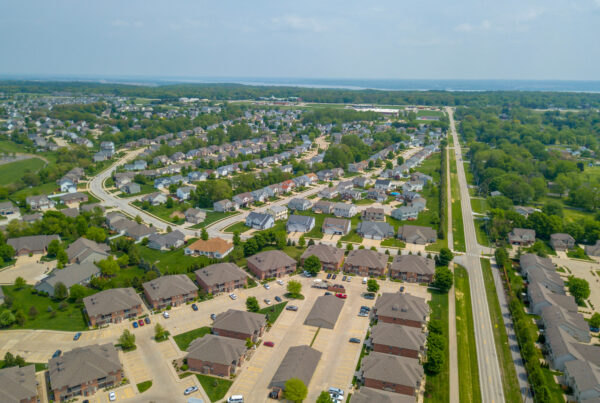

Ohio Is a Small Multifamily State, and That Changes the Product
Most investors approach Ohio thinking about single-family rentals. The more interesting opportunity and the one that changes your financing decision is the state’s unusually deep supply of small multifamily.
Ohio’s urban housing stock is full of doubles, triples, and fourplexes built when that was how cities housed people, and they trade at prices that would buy a single-family rental in most of the country. Five-to-eight unit buildings are also more available and more affordable here than almost anywhere.
That matters for one reason: combined rents across multiple units overcome cost burdens that sink single-unit ratios. A duplex producing $2,400 in total rent clears debt service coverage at a purchase price where a single-family at $1,300 would not.
The practical consequence is that in Ohio, DSCR is frequently available on multifamily where it is not on single-family and the 1099 loan becomes the tool for the single-unit purchases, the properties that need work first, and the borrowers who want better pricing than a DSCR file can deliver.
Establish which asset you are buying before you choose a product, and if your lender does not write 5-to-8 unit, find one who does before you rule out the category.
The Lenders
Select Home Loans
Select Home Loans is a Non-QM mortgage broker (NMLS #2384002) writing 1099 investor loans across Ohio. Appetite for 2-to-4 unit and 5-to-8 unit property varies considerably between wholesale investors some write it routinely, some not at all which is exactly the situation a broker resolves.
We quote DSCR and bank statement alternatives alongside the 1099 program so you can compare paths on the same property.
Get a quote · (888) 550-3296
Other lenders worth calling — listed in no particular order:
Brokers First Funding A wholesale Non-QM lender holding an Ohio Residential Mortgage Lending Act Certificate of Registration (#RM.805467.000) from the Ohio Department of Commerce, Division of Financial Institutions. Publishes Ohio-specific program mapping including Columbus and Intel-ecosystem bank statement, Cleveland Clinic DSCR, Cincinnati consulting, Hocking Hills cabin short-term rental, and 5-to-8 unit DSCR. Broker channel.
Capital Home Mortgage Ohio Ohio operations across 1099, bank statement, asset, and DSCR programs, with stated coverage of Columbus, Cleveland, and Cincinnati.
Mbanc A direct lender holding an Ohio Residential Mortgage Lending Act certificate of registration, publishing Non-QM programs across bank statement, 1099, asset utilization, and DSCR.
Angel Oak Mortgage Solutions One of the largest dedicated Non-QM investors nationally, with a purpose-built 1099 income program. Reached through a broker.
Griffin Funding Publishes qualifying on 90 to 100 percent of gross 1099 income, 620 minimum credit, and loan amounts to $4 million.
Newpoint Mortgage A Non-QM lender covering Ohio with DSCR, mixed-use, and closed-end DSCR second mortgage programs the mixed-use capability is relevant given Ohio’s inventory.
Verify current licensure and program availability before relying on any listing. See the disclaimer at the end of this page.
Ohio’s Corporate Alumni Consulting Class
Ohio has a distinctive 1099 population that follows from having three separate major-corporate metros.
Cincinnati produces consultants who spent careers at consumer-goods and retail companies headquartered there and now advise independently. Brand strategy, supply chain, category management high-earning, low-overhead, and almost entirely 1099.
Columbus has added a technology and semiconductor ecosystem alongside its long-standing insurance, retail, and university employment, and each layer generates independent contractors.
Cleveland supports a substantial healthcare consulting population around its hospital systems, plus manufacturing and industrial contractors.
These borrowers share the same profile: substantial documented 1099 income, minimal business expense, and tax returns that understate them because they deduct what they legitimately can. A gross-receipts 1099 program is the right tool for all of them, and it will typically produce more qualifying income than a bank statement program applying an expense factor to deposits.
How Qualifying Works
A 1099 loan qualifies you on income documented on your 1099 forms rather than the net profit shown after deductions.
Programs split into two camps. Some apply 90 percent or more of gross 1099 income with no expense deduction. Others apply an expense factor of 10 to 25 percent first.
On $180,000 of annual 1099 income:
| Method | Qualifying income |
|---|---|
| 90% of gross | $162,000/yr — $13,500/mo |
| Gross less 20% expense factor | $144,000/yr — $12,000/mo |
| Net profit from your tax return | frequently under $80,000 |
Model your payment with our mortgage calculators.
One year or two
One-year suits a consultant whose practice grew after going independent, particularly common in the corporate-alumni pattern above where the first partial year understates the run rate.
Two-year suits engagement-based consulting dependent on a small number of clients, and construction working a cold-weather season.
The two-year self-employment history requirement is separate from the two-year income lookback. Ask about both.
Ohio Investment Markets
Columbus has the strongest growth trajectory of the three metros, with university, state government, insurance, and now semiconductor employment. Investor competition is real and appraisal support is solid.
Cleveland offers the highest raw yields in the state, with deep small-multifamily inventory and meaningful variation in condition between neighborhoods.
Cincinnati sits between the two on both price and yield, with strong historic multifamily stock in the urban core.
Dayton and the Wright-Patterson corridor support steady rental demand from a large defense employment base.
Hocking Hills and Lake Erie islands are seasonal short-term rental markets cabin and waterfront inventory whose annualized rent gets discounted, making the 1099 path cleaner than DSCR.
Smaller cities Toledo, Akron, Youngstown, Canton offer the lowest entry prices and are where loan minimums bind. A meaningful share of inventory prices below common Non-QM floors of roughly $75,000 to $150,000.
Other Ohio Specifics
Judicial foreclosure. Ohio forecloses through the courts, which lengthens timelines and makes Non-QM investors modestly more conservative on leverage than in a power-of-sale state.
Municipal rental registration and inspection. Several Ohio cities require registration of rental property and periodic inspection, with meaningful variation between them. Confirm compliance status before applying on a refinance of an existing rental it speeds the property-side review considerably.
Older housing stock. Ohio’s urban cores are largely pre-1978 and often pre-1940, bringing lead disclosure obligations and more frequent deferred-maintenance flags. Heating systems, roof age, and foundation condition surface routinely in appraisals.
Property taxes vary by school district, not just by county, and the variation is large enough to matter. Pull the actual bill.
Investment Property Terms
- Down payment: 20–25 percent typical, better pricing at 25 percent and above; expect the higher end on 5-to-8 unit
- Credit: 620 floor at most investors; real improvements at 680, 700, 740
- Reserves: 6–12 months PITIA, often with additional reserves per financed property already owned
- Prepayment penalties: common on investment property, typically 1–3 years, often buyable at a quarter to a half point
Compare with our purchase loan options and refinance loan options.
1099 or DSCR?
Use DSCR on 2-to-4 unit and 5-to-8 unit, where combined rents carry the file comfortably. This is Ohio’s strongest DSCR case and it is genuinely strong.
Use a 1099 loan on single-family purchases in the higher-priced Columbus submarkets, on anything below a DSCR investor’s loan minimum, on Hocking Hills or Lake Erie seasonal property, on properties needing work before they rent, or where your documented consulting income unlocks better pricing than the property can.
If you already hold Ohio rentals, a DSCR refinance works well here, particularly on multifamily.
Questions to Ask
- Do you write 5-to-8 unit, and at what LTV?
- Do you qualify on gross 1099 income, or apply an expense factor?
- What is the actual tax bill for this school district?
- What is your minimum loan amount? (Ask this in Toledo, Akron, Youngstown, Canton.)
- Does this municipality require rental registration?
- Can you quote DSCR on the same property?
More from Select Home Loans: DSCR loans · DSCR refinance · Learning Center · About Select
Disclaimer
The lenders described on this page are listed in no particular order. Select Home Loans appears first because we publish this page and originate these loans; we have a commercial interest in this category. No lender listed has paid for placement.
This page reflects our opinion based on publicly available information at the time of writing. It is general information, not a recommendation, an endorsement, or an offer of credit. Lender programs, guidelines, licensure, pricing, and availability change frequently and without notice, and nothing here guarantees that any lender is currently licensed in Ohio, currently offers the program described, or will approve your file.
Municipal rental registration requirements, school district tax rates, and short-term rental ordinances vary and change; verify independently. Consult a licensed mortgage professional and where appropriate a tax advisor, attorney, or financial advisor before making any borrowing decision. Verify any lender’s licensure through NMLS Consumer Access at nmlsconsumeraccess.org.
Select Home Loans, NMLS #2384002. Equal Housing Opportunity.