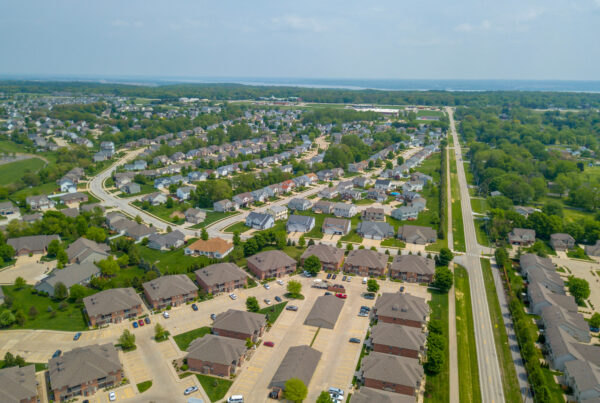
An investor from California closes on a rental house in a Frisco subdivision north of Dallas. The purchase went smoothly, the tenant moved in fast, and the rent came in right where the listing agent predicted. Then the first escrow analysis arrives, and the property tax line is several times what a similar house would carry back home. The deal still works, but the margin is thinner than the spreadsheet promised, because the spreadsheet was built with out-of-state assumptions.
That story plays out constantly across Texas, and it is the single most useful thing to understand before you finance investment property here. Texas has no state income tax, which is a big part of why people and companies keep relocating to Dallas-Fort Worth, Houston, Austin, and San Antonio. The state pays for that arrangement largely through property taxes, and property taxes sit inside the monthly payment your lender uses to qualify the loan. Get that number wrong and your financing math is wrong from the first page.
The good news is that asset-based loans are built for exactly this kind of analysis. Instead of asking for your tax returns and W-2s, these programs qualify you on what the property earns, what your business deposits show, or what your assets can support. For investors buying across the biggest investor market in the country, that flexibility matters more here than almost anywhere else.
This guide ranks the best asset-based loan programs for Texas investors, explains how the state’s tax structure and insurance realities shape each one, covers a Texas-specific legal wrinkle around equity lending, and lists the lenders worth calling. By the end you should know exactly which program fits your next deal in Plano, Katy, New Braunfels, or Fredericksburg.
What Asset-Based Lending Means for a Texas Investor
Asset-based lending, often grouped under the non-QM umbrella, flips the usual mortgage question. A conventional lender asks whether your personal income, documented through tax returns, supports the payment. An asset-based lender asks whether the asset itself, or your broader financial picture, supports the loan. That might mean the rental income a Houston fourplex produces, the deposits flowing through a San Antonio contractor’s business bank account, or the brokerage portfolio a retired Austin tech employee built over twenty years.
For Texas investors this is not a niche workaround. It is often the only sensible path. The state runs on entrepreneurs, 1099 contractors, oilfield services operators, and small business owners whose tax returns are legally minimized and therefore useless for conventional qualifying. Add in out-of-state buyers purchasing multiple properties per year, and full-doc lending simply cannot keep up with how Texas investors actually operate.
Here is how the main programs stack up for this market.
The Best Asset-Based Loan Programs for Texas Investors, Ranked
1. DSCR Loans: The Workhorse, With a Texas-Sized Tax Caveat
A DSCR loan qualifies the property instead of the person. The lender takes the monthly rent and divides it by the full monthly payment, meaning principal, interest, property taxes, insurance, and any association dues, together called PITIA. If the rent covers the payment, the deal generally qualifies. No tax returns, no employment verification, no debt-to-income calculation on your personal finances.
In most states, the tax and insurance portion of PITIA is a modest slice of the payment. In Texas, property taxes are a heavyweight line item. Because the tax bill sits inside PITIA, a Texas property needs stronger rent relative to its price to hit the same DSCR ratio as an identical property in a low-tax state. Two houses with the same price and the same rent can produce meaningfully different DSCR results purely because one sits in a high-tax Texas school district and the other does not.
That is not a reason to avoid Texas. Rents across DFW, Houston, and San Antonio have historically been strong enough to carry the tax load on well-bought properties. It is a reason to underwrite carefully. A few practical habits separate experienced Texas DSCR borrowers from surprised ones:
- Pull the actual current tax bill from the county appraisal district, not a national listing site’s estimate, before you write the offer.
- Assume the taxable value resets after your purchase. Appraisal districts reassess, and a long-held property’s old tax bill can understate what you will pay as the new owner.
- Know whether the property carries any special district assessments, such as a municipal utility district in a newer suburb, since those raise the effective carry.
- Remember that homestead-related tax treatment belongs to owner-occupants. As an investor you generally will not receive it, so do not model your carry off what the current owner-occupant pays.
Texas property owners also have a well-established culture of protesting assessed values each year, and many investors treat the protest calendar as part of normal asset management. Whether a protest succeeds varies case by case, but your lender will underwrite off the tax figures available at the time, so build your DSCR math on real numbers rather than hoped-for reductions.
Who fits DSCR loans in Texas: long-term rental buyers in the suburban rings around Dallas-Fort Worth, Houston, San Antonio, and Austin, portfolio builders scaling past the conventional loan-count ceiling, and out-of-state investors who want to qualify without shipping two years of personal tax documents. Short-term rental investors in the hill country use DSCR programs too, which we will cover shortly.
Trade-offs: pricing runs above conventional owner-occupied loans, and most DSCR programs carry prepayment penalty structures that vary by lender. Specific credit minimums, LTV caps, and DSCR thresholds are program-dependent and subject to investor guidelines, so treat any number you see online as a starting point for a conversation, not a promise.
2. Bank Statement Loans: Built for the Texas Entrepreneur Economy
If DSCR loans are the workhorse for pure rental deals, bank statement loans are the answer for the enormous population of Texans who own businesses. Houston’s energy services firms, DFW’s logistics and construction operators, Austin’s consultants and startup founders, San Antonio’s trades and medical practices: a huge share of the state’s investor class earns income that looks thin on a tax return and healthy in a bank account.
A bank statement loan qualifies you on 12 or 24 months of business or personal bank deposits instead of tax returns. The lender applies an expense factor to business deposits to estimate usable income, then underwrites the loan on that figure. For a self-employed borrower who writes off aggressively, the difference between tax-return income and bank-statement income can be the difference between a denial and an approval.
Texas gives this program an extra edge. Because there is no state income tax, self-employed Texans often run leaner personal tax pictures than their counterparts elsewhere, and the gap between reported income and real cash flow can be wide. Bank statement underwriting closes that gap.
Who it fits: self-employed investors buying rentals in their own name or an entity, business owners purchasing a property that a DSCR calculation alone will not carry, and borrowers combining a primary residence purchase with an investment strategy. Trade-offs: more documentation than DSCR, since the lender reviews months of statements and may ask about large or irregular deposits, and expense factors vary by program and business type.
3. Asset Depletion Loans: Qualifying Off What You Have Already Built
Asset depletion, sometimes called asset utilization, converts liquid assets into qualifying income. The lender takes eligible assets, such as brokerage accounts, retirement funds, and cash, and divides them over a defined term to produce a monthly income figure for underwriting. No employment, no tax returns, no rental analysis required.
This program has a natural audience in Texas. Austin’s tech economy has produced a generation of employees holding significant equity compensation and investment portfolios, some of whom have stepped away from W-2 life entirely. Retirees relocating to the hill country or the coast often arrive asset-rich and income-light on paper. Sellers of businesses across DFW and Houston frequently sit on large liquid positions between ventures. For all of them, asset depletion turns a strong balance sheet into loan approval.
Who it fits: high-net-worth buyers without traditional income documentation, early retirees, and investors who prefer not to tie qualification to a specific property’s rent. Trade-offs: you need substantial eligible assets, and the calculation method, eligible asset types, and haircuts applied vary by lender.
4. P&L and 1099 Loans: Lighter-Documentation Cousins
Two briefer options round out the income-flexible menu. A P&L loan qualifies a self-employed borrower on a profit and loss statement, typically prepared or reviewed by a CPA or licensed tax preparer, useful when bank statements are messy across multiple accounts or the business structure complicates deposit analysis. A 1099 loan qualifies independent contractors on their 1099 forms alone, a fit for the many Texas realtors, drivers, consultants, and gig-economy earners whose income is real but never appears on a W-2. Both are program-dependent in their requirements, and both are worth asking about if bank statement underwriting does not fit your paperwork.
5. Bridge and Short-Term Financing: For the Value-Add Play
Texas metros still contain aging housing stock ripe for renovation, from mid-century houses inside Loop 610 in Houston to older neighborhoods in Fort Worth and San Antonio. Bridge loans and fix-and-flip lines fund the purchase and rehab on a short timeline, qualified primarily on the asset and the plan rather than personal income. The common Texas play is buy, renovate, lease, then refinance into a long-term DSCR loan once the property is stabilized. Bridge money costs more and runs shorter, so it belongs in a plan with a clear exit, not as permanent financing.
The Texas Equity Rules Every Investor Should Know About
Texas has its own constitutional framework around home-equity lending, and it is distinctive enough that investors should be aware of it even though it mostly is not about them. The rules primarily govern equity lending against owner-occupied homesteads, where Texas imposes protections and limits that do not exist in most states. Lending against investment property is treated differently, because a rental you do not live in is generally not your homestead.
For investors, the practical takeaways are simple. First, if you are pulling cash out of a Texas rental property, the transaction usually falls outside the homestead rules, but the analysis depends on the facts of your situation, including how the property is occupied and titled. Second, if a property was ever your homestead, or a family member lives there, or you are house-hacking, the picture gets more nuanced. Do not rely on a general article, this one included, for legal conclusions. Confirm how the rules apply to your specific transaction with your lender and, where appropriate, a Texas real estate attorney or title company. The rules are specific, they are taken seriously at closing, and getting the classification right up front prevents delays later.
Coastal Wind, Hill Country Weekends: Insurance and STR Realities
Two Texas submarkets deserve their own word, because they change the underwriting math.
On the coast, Galveston and Corpus Christi offer some of the most compelling short-term and long-term rental pricing in the state, but coastal Texas property carries windstorm and flood insurance considerations that inland properties do not. Those premiums live inside PITIA, which means they compress DSCR the same way property taxes do. Before writing a coastal offer, get real insurance quotes, including windstorm coverage and flood insurance where the zone requires it. A deal that pencils with an inland insurance assumption can fail underwriting once coastal premiums enter the payment.
In the hill country, Fredericksburg has become one of the best-known short-term rental markets in the state, drawing wine-country and Main Street tourism year-round, with Wimberley, Dripping Springs, and the Canyon Lake area close behind. Many DSCR programs can underwrite short-term rentals, sometimes using market rent analysis and sometimes using documented booking history, with methods varying by lender. STR investors here should also verify local permitting and any city or county rules on short-term rentals before closing, since regulations differ from town to town and change over time.
Choosing a Program Across Four Very Different Metros
Part of what makes Texas the biggest investor market in this series is that it is really four markets wearing one flag. Dallas-Fort Worth offers an enormous sprawl of suburban single-family rentals, fed by relentless corporate relocation. Houston brings sheer scale and economic diversity, from energy to medicine to the port, with price points that let investors start smaller. San Antonio is the steady performer, anchored by military installations, healthcare, and a lower cost basis that suits patient buy-and-hold investors. Austin runs on its tech economy, with more price volatility but a deep pool of high-earning tenants.
A sensible way to match programs to metros: DSCR loans fit the suburban rental machine in DFW, Houston, and San Antonio, where rent-to-payment math is the whole game and the property tax line decides which deals clear. Bank statement loans fit self-employed buyers everywhere, but especially Houston and DFW, where the entrepreneur economy is densest. Asset depletion fits Austin’s equity-rich tech alumni and hill country retirees. Bridge financing fits value-add plays in the older inner neighborhoods of all four metros. Many Texas investors deliberately spread purchases across two or more of these metros to diversify tenant bases and local economies, and asset-based programs make that easier because each new loan qualifies on its own property or on your documented assets, not on a personal income figure that a growing portfolio would eventually exhaust.
A Worked Example: DSCR Math on a DFW Suburban Rental
The numbers below are round and illustrative, not market data, but they show how the Texas tax line changes the calculation.
| Item | Illustrative figure |
| Purchase price | $320,000 |
| Down payment (20%) | $64,000 |
| Loan amount | $256,000 |
| Monthly rent | $2,600 |
| Principal and interest | $1,700 |
| Monthly property taxes | $550 |
| Monthly insurance | $150 |
| Total PITIA | $2,400 |
| DSCR (rent ÷ PITIA) | About 1.08 |
Notice how much of the payment the tax line consumes. In a lower-tax state, that same house might carry a DSCR comfortably above 1.20 with identical rent. In Texas, the deal still qualifies under many programs, but the cushion is thinner, and a buyer who modeled taxes at half the real figure would have believed the cushion was twice as thick. If the taxable value resets upward after purchase, the ratio tightens further. This is why experienced Texas DSCR investors verify county tax data before making offers, and why a broker who runs your numbers across multiple programs can find the one that prices your specific ratio best.
Best Asset-Based Lenders Serving Texas Investors
1. Select Home Loans
Select Home Loans is a nationwide investor-loan broker specializing in non-QM and asset-based programs, including DSCR loans, bank statement loans, asset depletion, P&L loans, and 1099 programs. Rather than boxing you into one lender’s guidelines, Select shops a single application across a network of wholesale lenders and investors, which matters in Texas, where a heavy tax bill or coastal insurance quote can make one program’s math fail while another’s works. For investors comparing structures across DFW, Houston, San Antonio, and Austin, that breadth is the practical advantage. Reach Nick at (888) 550-3296 or selecthomeloans.com, NMLS #2384002.
2. Easy Street Capital
An Austin-based investor lender known for DSCR loans and short-term bridge and fix-and-flip financing. Its home-state familiarity with Texas investor deals, including short-term rental markets, has made it a recognizable name among local operators.
3. Kiavi
A large national lender for real estate investors, widely known for fix-and-flip bridge loans and DSCR rental financing with a technology-driven application process. A common choice for investors running renovation-to-rental strategies at volume.
4. Visio Lending
A DSCR-focused rental lender, also headquartered in Texas, concentrating on long-term financing for single-family and small residential rentals, including vacation rentals. Its narrow focus on rental property lending is its calling card.
5. CoreVest
A national lender oriented toward portfolio investors, known for blanket loans across multiple rental properties, build-to-rent financing, and credit lines for larger operators. A fit for investors consolidating a multi-property Texas portfolio under one facility.
6. Angel Oak Mortgage Solutions
One of the most established names in non-QM lending, with a broad menu that includes bank statement, DSCR, and other alternative documentation programs, typically accessed through brokers. Known for depth across self-employed borrower scenarios.
This list reflects the author’s opinion, is presented in no particular order beyond that preference, and every investor should compare current programs, pricing, and terms for their own situation before choosing a lender.
Qualifying and Closing: What the Process Looks Like
Asset-based loans follow a familiar arc even though the documentation differs. You start with a scenario conversation and pre-qualification, where the broker matches your deal to programs whose guidelines fit your credit profile, down payment, and property type. Expect requirements such as minimum credit scores, maximum LTVs, DSCR thresholds, and reserve requirements to be program-dependent and subject to investor guidelines; stronger credit and larger down payments generally open better pricing and higher leverage, but the specific cutoffs vary by lender.
From there the file moves through appraisal, which for DSCR loans includes a market rent analysis, then underwriting, where the lender verifies the property’s income math, your assets for closing, and the insurance and tax figures that feed PITIA. Texas deals add the usual state-specific steps at title, and coastal properties add windstorm and flood documentation. Timelines vary by transaction, so build your contract dates with your lender rather than assuming a fixed number of days. Down payments for investor programs are typically larger than owner-occupied loans, and closing costs include the standard mix of lender, title, and escrow items plus prepaid taxes and insurance, which in Texas means the tax escrow is a number worth previewing early.
Frequently Asked Questions
How do Texas property taxes affect my DSCR loan approval?
Directly. The lender divides monthly rent by the full PITIA payment, and property taxes are part of PITIA. A higher tax bill lowers the ratio, which can reduce your maximum loan amount or change which program fits. Always underwrite with the county’s actual figures and assume reassessment after purchase.
Can I use a property tax protest to improve my qualifying numbers?
Not at approval time. Lenders underwrite with the tax figures available when the loan is processed. Protesting your assessed value is a normal part of owning Texas property and can help your cash flow in later years, but treat any reduction as a future bonus, not a qualifying tool.
Do Texas home-equity rules stop me from doing a cash-out refinance on a rental?
Generally the distinctive Texas homestead equity rules apply to owner-occupied homesteads, and investment property cash-out refinances are treated differently. That said, occupancy history and titling details matter, so confirm how the rules apply to your specific transaction with your lender and title company before you count on the proceeds.
Can I finance a Fredericksburg short-term rental with a DSCR loan?
Many DSCR programs accommodate short-term rentals, using either a market rent figure or documented booking income depending on the lender. Hill country STR markets like Fredericksburg are well known to non-QM lenders. Verify local permitting rules yourself, since city and county STR regulations vary and change.
What about insurance on Galveston or Corpus Christi properties?
Coastal Texas properties typically need windstorm coverage and, in mapped flood zones, flood insurance. Those premiums sit inside PITIA and lower your DSCR, so get real quotes before you write the offer, not after the appraisal comes back.
Is it smart to spread purchases across Dallas, Houston, San Antonio, and Austin?
Many investors do exactly that, because the four metros run on different economic engines: corporate relocation in DFW, energy and medicine in Houston, military and healthcare in San Antonio, tech in Austin. Asset-based loans suit this strategy since each purchase qualifies on its own property income rather than draining a personal debt-to-income budget.
Can I close in an LLC?
Most DSCR and investor bridge programs allow, and some encourage, closing in an entity such as an LLC. Bank statement and asset depletion loans are more often personal-name loans, though structures vary. Tell your broker your intended vesting early so the file is built correctly.
I own a business in Houston and write off most of my income. Which program fits me?
Start with a bank statement loan, which qualifies you on deposits rather than tax returns. If your statements are complicated, a P&L loan may work instead. If the purchase is a pure rental, a DSCR loan may sidestep your personal income entirely.
How many financed properties can I have with these programs?
Asset-based programs are built for portfolios, and many have no fixed cap on financed properties, unlike conventional lending. Limits that do exist are program-dependent, so a broker can route a large portfolio to lenders comfortable with it.
Do these loans have prepayment penalties?
Most DSCR loans carry prepayment penalty structures, often with options to buy the penalty down or shorten it. Terms vary by lender and affect pricing, so decide how long you plan to hold before you pick a structure.
Will a new-construction suburb’s special taxing district affect my loan?
It can. Newer master-planned communities around DFW, Houston, and San Antonio often sit in special districts with additional assessments, which raise the effective tax load inside PITIA. Ask for the full tax picture, including any district assessments, when you evaluate the deal.
Are asset-based loan programs available everywhere in Texas?
Program availability and guidelines vary by lender and can change, and not every lender offers every program in every scenario. Confirm availability for your property type and location with a loan expert before relying on a specific program.
The Bottom Line on Asset-Based Loans in Texas
Texas rewards investors who respect its math. The absence of a state income tax pulls tenants and businesses in, and the property tax system that funds the state sits squarely inside the payment your lender uses to qualify every deal. Investors who verify county tax data, price coastal insurance early, understand how the homestead equity rules do and do not touch their transactions, and match the right program to the right metro consistently outperform those who import assumptions from other states.
The best asset-based loans for investors in Texas are the ones matched to your specific deal: DSCR for the rental machine, bank statement loans for the entrepreneur economy, asset depletion for the balance-sheet buyer, and bridge money for the value-add play. Programs, guidelines, and requirements change over time, so verify current details with a loan expert before you commit to a structure.
Talk Through Your Texas Deal
If you are weighing a suburban rental in DFW, a fourplex in Houston, a hill country STR, or your first San Antonio buy-and-hold, a short conversation can tell you which programs your numbers actually fit. Call Nick at (888) 550-3296 or visit Select Home Loans, NMLS #2384002 | Email: info@selecthomeloans.com, to compare loan options and request a current quote. Bring the county tax figures and an insurance estimate, and you will get an answer grounded in real Texas math.