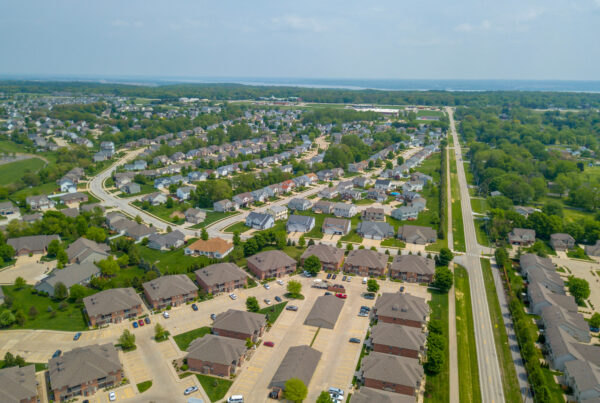
There are not many states where an investor can check on every property they own before lunch. Rhode Island is one of them. From a triple-decker on the West End of Providence, you can be at a two-family in Pawtucket in fifteen minutes, a Woonsocket rental in thirty, and a Newport seasonal property in under an hour. For landlords who like to self-manage, that compactness is a real business advantage, and it shapes how smart investors here build and finance their portfolios.
Picture a common scenario. An investor finds a three-unit triple-decker near the hospital district in Providence for $520,000. Two units are rented to hospital staff, the third to a pair of graduate students. The building cash flows nicely, but the buyer is self-employed and just wrote off a large chunk of income on last year’s tax return. A conventional lender looks at that return and says no. The property itself, meanwhile, is telling a completely different story.
That gap is exactly what asset-based lending exists to close. Instead of qualifying you on tax returns and W-2s, these loan programs qualify you on what you actually have: the rent a property produces, the deposits flowing through your business, or the liquid assets sitting in your accounts.
This guide ranks the best asset-based loan programs for Rhode Island investors, walks through the math on a typical triple-decker deal, lists the lenders worth knowing, and answers the questions Rhode Island landlords actually ask, from student tenants on Providence’s East Side to the summer rental economy in Newport.
What Asset-Based Lending Means for a Rhode Island Investor
Asset-based loans, often grouped under the non-QM umbrella, flip the usual underwriting question. A conventional lender asks whether your personal income supports the payment. An asset-based lender asks whether the asset supports the loan. That asset might be the rental property itself, your bank deposits, or your investment portfolio.
For Rhode Island, this matters more than in most states. The rental stock here skews heavily toward older two-to-four unit buildings, the classic New England triple-decker chief among them. Those small multifamily properties are exactly what rental-income-based programs were built for. At the same time, the state has a meaningful population of self-employed tradespeople, restaurant owners, fishermen, and seasonal business operators whose tax returns rarely reflect their real earning power, plus a concentration of wealth around Newport and the East Side that lends itself to asset-driven qualifying.
Here are the programs, ranked for how well they fit Rhode Island investors specifically.
Ranked: The Best Asset-Based Loan Programs for Rhode Island Investors
1. DSCR Loans: Built for the Triple-Decker
If you are buying rental property in Rhode Island, the DSCR loan is the program to understand first. DSCR stands for debt service coverage ratio, and the concept is simple: the lender compares the property’s monthly rent to its full monthly payment, meaning principal, interest, taxes, insurance, and any association dues (PITIA together). Rent divided by PITIA gives you the ratio. A ratio of 1.0 means the rent exactly covers the payment. Above 1.0, the property carries itself.
No tax returns. No employment verification. No debt-to-income calculation. The building qualifies, not your pay stub.
Here is why this program dominates in Rhode Island. Triple-deckers and other 2-4 unit properties stack three or four rent checks on top of a single mortgage payment, a single roof, and a single tax bill. That structure tends to produce stronger coverage ratios than a single-family rental at the same price point.
Example, using round illustrative numbers only. Say that Providence triple-decker rents each unit for $1,700, so $5,100 in total monthly rent. Suppose the full PITIA payment on the proposed loan works out to $3,900 a month. The DSCR is 5,100 divided by 3,900, or roughly 1.31. Most DSCR programs treat a ratio in that range favorably, and stronger ratios can improve pricing and leverage. The exact thresholds vary by lender and program, so treat these numbers as a way to understand the math, not as a quote.
The compact-portfolio angle matters here too. Because everything in Rhode Island sits within a short drive, many local investors self-manage. That keeps management fees out of the operating picture and lets a hands-on landlord run four or five buildings across Providence, Cranston, and Pawtucket without hiring anyone. DSCR lenders do not require you to use professional management, and since the qualifying ratio is based on rent versus PITIA rather than your personal income, a self-managing landlord with a day job or an unusual tax situation qualifies on the same footing as anyone else.
Where DSCR loans fit best in Rhode Island: Providence triple-deckers and two-families serving Brown University, RISD, and hospital-system employees; value-priced multifamilies in Pawtucket, Central Falls, and Woonsocket where purchase prices are lower and rent coverage is often strong; and long-term rentals in Warwick and Cranston. Trade-offs: down payments are larger than owner-occupied loans, prepayment penalty structures are common (and usually negotiable in exchange for pricing), and a property with weak rent coverage may need more money down.
2. Asset Depletion Loans: Newport Wealth, Retiree Portfolios
Rhode Island’s second-best fit is the asset depletion loan, sometimes called asset utilization. This program converts your liquid assets into a qualifying income stream. In broad terms, the lender totals your eligible assets, things like brokerage accounts, cash, and often a percentage of retirement funds, then divides by a set number of months to create a monthly income figure for underwriting. The exact eligible assets, percentages, and divisor vary by program.
Who is this for in Rhode Island? Think about the wealth concentrated around Newport, Jamestown, and the East Side of Providence. Plenty of would-be investors there are retirees, business sellers, or households living off portfolios rather than paychecks. A retired couple with $1.5 million in investments and almost no reported income can be a difficult file for a conventional lender and an easy one for an asset depletion program.
It also pairs naturally with the Newport-area property profile. High-end seasonal rentals and second homes near the water often attract buyers whose balance sheets are far stronger than their tax returns. Asset depletion lets that balance sheet do the qualifying without forcing anyone to liquidate positions or restructure income.
Trade-offs: you need substantial liquid assets for the math to work, and lenders discount certain asset types. It is generally not the tool for a leveraged investor building a portfolio from scratch. For that investor, DSCR remains the workhorse.
3. Bank Statement Loans: For Rhode Island’s Self-Employed
Third on the list, and first for a specific group: business owners. A bank statement loan qualifies you on 12 or 24 months of business or personal bank deposits instead of tax returns. The lender applies an expense factor to business deposits to estimate usable income, with the specifics varying by program.
Rhode Island runs on small business. Restaurant operators on Federal Hill, contractors renovating the state’s older housing stock, fishing and marine trade operators in Galilee and along Narragansett Bay, and a growing base of remote consultants and 1099 professionals all share the same problem: aggressive but legal write-offs shrink taxable income while cash flow stays healthy. Bank statements show the cash flow the tax return hides.
For investment property purchases, many self-employed buyers still end up in a DSCR loan because it is simpler. But bank statement programs earn their spot when the property’s rent coverage is thin, when the buyer wants to qualify for a second home or a property DSCR does not fit, or when the deal needs personal income in the picture. They are also the go-to for self-employed borrowers refinancing a primary residence to pull equity for the next investment.
4. P&L, 1099, and Bridge Options: The Supporting Cast
Three more programs deserve a brief mention. P&L statement loans qualify a business owner using a profit and loss statement, typically prepared or reviewed by a tax professional, which helps when bank statements are messy or income is trending upward. 1099 loans serve contractors and commission earners who receive 1099s, qualifying on gross 1099 income rather than net taxable income.
Bridge and short-term loans matter in Rhode Island because of the age of the housing stock. Much of the state’s inventory predates World War II, and plenty of triple-deckers need real work before they rent at full potential. A bridge loan funds the purchase and renovation, then the investor refinances into a long-term DSCR loan once the units are stabilized. That buy, renovate, rent, refinance sequence is one of the most common playbooks in Providence, Pawtucket, and Woonsocket right now.
Matching the Program to the Deal: A Rhode Island Cheat Sheet
| Your situation | Strongest first look |
| Buying a rented triple-decker or 2-4 unit | DSCR loan |
| Retiree or high-net-worth buyer, low reported income | Asset depletion |
| Self-employed, healthy deposits, thin tax returns | Bank statement loan |
| Contractor or commission earner on 1099s | 1099 loan |
| Property needs renovation before it rents well | Bridge, then DSCR refinance |
| Newport seasonal rental with strong summer income | DSCR (ask how the program treats short-term rents) |
Two Rhode Island-specific notes on choosing. First, on seasonal properties: Newport, Narragansett, and the South County beach towns earn most of their rent between Memorial Day and Labor Day. DSCR programs handle short-term and seasonal rental income differently from lender to lender. Some use market long-term rent from the appraisal, others can consider documented short-term rental history. This is a spot where working with a broker who knows which programs allow what saves real time.
Second, on older buildings: appraisals on century-old housing stock can come with condition notes. Deferred maintenance that affects safety or habitability can complicate a long-term loan, which is another reason bridge-to-DSCR is such a common path here.
Best Asset-Based Lenders Serving Rhode Island Investors
1. Select Home Loans
Select Home Loans tops this list because of how it operates: as a nationwide mortgage broker focused on investor and non-QM lending, not a single-program lender. One application gets shopped across a network of wholesale lenders and investors, which matters in a state like Rhode Island where the right home for a deal might be a DSCR program that is friendly to student-heavy triple-deckers, an asset depletion program for a Newport buyer, or a bank statement program for a Federal Hill restaurant owner. Rather than forcing your deal into one credit box, Select compares boxes. Nick and the team walk investors through DSCR math, documentation options, and prepayment structures before anything is locked in. Reach them at (888) 550-3296 or selecthomeloans.com, NMLS #2384002.
2. Deephaven Mortgage
Deephaven is one of the longer-standing names in non-QM lending, with a menu that spans DSCR, bank statement, and asset utilization programs. The company is known for underwriting flexibility on borrower profiles that fall outside agency guidelines, which suits self-employed and portfolio-building investors.
3. A&D Mortgage
A&D Mortgage offers a wide non-QM lineup, including DSCR and bank statement products, and is known for working with a broad range of borrower scenarios through the wholesale channel. Investors with layered situations, such as self-employment plus multiple financed properties, often find a fit here.
4. RCN Capital
RCN Capital focuses on investor lending, with a reputation built on fix-and-flip, bridge, and long-term rental financing. For Rhode Island investors running the renovate-then-refinance playbook on older multifamilies, RCN’s short-term products are worth a look.
5. Truss Financial Group
Truss Financial Group concentrates on self-employed and non-traditional income borrowers, with bank statement and DSCR options among its offerings. Business owners who have been turned away over tax-return income are the core audience.
6. Acra Lending
Acra Lending is a well-known non-QM lender with programs covering DSCR, bank statement, and other alternative documentation loans. It is a frequent stop for investors and self-employed borrowers who need common-sense underwriting.
This list reflects the author’s opinion and, beyond the author’s preference for Select Home Loans, is presented in no particular order. Every investor’s situation is different, so compare programs, pricing, and terms for your own deal before committing.
Qualifying and Closing: What to Expect
Requirements for asset-based loans are program-dependent and set by each lender’s investor guidelines, so treat everything below as directional.
Credit still matters even without tax returns. Stronger scores generally open up higher leverage and better pricing, while lower scores usually mean more money down. Down payments on investment properties run higher than owner-occupied loans, and the exact minimum shifts with credit, DSCR ratio, property type, and program. Most programs want to see some cash reserves after closing, measured in months of payments, with the number varying by lender. Prepayment penalties are common on DSCR loans, and the structure you choose affects your rate, so decide how long you plan to hold before you pick one.
The process itself follows familiar stages: application and program selection, then appraisal (with a rent schedule on DSCR deals), then underwriting focused on the asset and your documentation type, then closing. Many investors close in an LLC, which most DSCR programs allow. Timelines vary by transaction, and older Rhode Island properties can add appraisal or insurance steps, so build in margin if you are working against a purchase contract date.
Pricing on all of these programs moves with credit score, loan-to-value, DSCR ratio, property type, documentation type, and prepayment structure. Nobody can quote you a real number without those inputs, so be skeptical of any advertised rate and request a quote based on your actual deal.
Frequently Asked Questions
Do DSCR lenders have a problem with student tenants near Brown and RISD?
Generally no. DSCR underwriting looks at rent versus PITIA, not who signs the lease. The appraiser’s rent schedule reflects market rent for the units. That said, some programs ask about lease terms, and buildings rented by the room can be treated differently than buildings leased by the unit, so disclose the setup early.
How do lenders handle a Newport property that earns most of its rent in summer?
It depends on the program. Some DSCR lenders qualify seasonal and short-term rentals using the appraiser’s market long-term rent, which understates a strong summer property but keeps the loan simple. Others can consider documented short-term rental income history. A broker can point you to programs that credit seasonal income rather than ignoring it.
Will the age of a triple-decker hurt my appraisal?
Age alone does not. Condition can. Appraisers flag items affecting safety, soundness, or habitability, and open issues like active leaks or missing systems can hold up a long-term loan. Cosmetic dating is fine. If a building needs real work, a bridge loan into a DSCR refinance is often the cleaner route.
Can I use one lender for properties in Rhode Island, Massachusetts, and Connecticut?
Often yes, and this is one advantage of working with a nationwide broker. Many Rhode Island investors end up owning across the border in Fall River, New Bedford, Attleboro, or eastern Connecticut, since those markets sit within the same easy driving radius. Program availability varies by state, so confirm your target states with your loan expert up front.
Do I need a property manager to get a DSCR loan?
No. DSCR programs do not require professional management, which suits Rhode Island’s self-managing landlords well. The qualifying math is the same either way.
Can I close a DSCR loan in an LLC in Rhode Island?
Most DSCR programs allow closing in an LLC, and many investors prefer it for liability planning. Expect the lender to review the entity documents and usually require personal guarantees from the members. Talk to your attorney about the right structure.
What if my triple-decker has a vacant unit at closing?
Many DSCR programs can use the appraiser’s market rent for vacant units rather than requiring signed leases on every door, especially on purchases. Guidelines differ by lender, so mention vacancies when you apply.
Is asset depletion only for retirees?
No. It works for anyone with substantial liquid assets and limited documented income: business sellers, people between ventures, trust beneficiaries, or high-net-worth households near Newport or the East Side buying investment or second properties. The common thread is a strong balance sheet doing the qualifying.
How many properties can I finance with DSCR loans?
DSCR programs are typically friendlier to multiple financed properties than conventional loans, which cap your count. Limits on total exposure with a single lender vary by program, which is another reason access to multiple wholesale lenders helps as your Rhode Island portfolio grows past a handful of doors.
Do bank statement loans work for a seasonal business, like a South County restaurant?
They can. Twenty-four month programs average your deposits across the full cycle, which smooths out a business that earns heavily in summer. A 12-month program that happens to capture your strong season may also work. The right lookback period depends on your deposit pattern.
What down payment should I plan for on a Pawtucket or Woonsocket multifamily?
Plan for an investment-property down payment that is larger than an owner-occupied loan, with the exact figure driven by credit, DSCR, and program. The upside of those markets is the entry price: lower purchase prices mean the same savings stretch further, which is why many investors start there before moving up to Providence or Newport assets.
Are there prepayment penalties on these loans, and can I avoid them?
DSCR loans commonly carry prepayment penalty periods, and the structure is usually a choice: accept a longer penalty period for better pricing, or pay for a shorter one or none at all. If you expect to sell or refinance quickly, say so up front and price the loan accordingly. Bank statement and asset depletion loans on owner-occupied homes are treated differently, so ask about your specific scenario.
The Bottom Line for Rhode Island Investors
Rhode Island rewards investors who move decisively on small multifamily deals, and asset-based loans for investors in Rhode Island are built for exactly that. DSCR loans fit the state’s triple-decker DNA and its self-managing, drive-everywhere landlords. Asset depletion serves the Newport and East Side buyer whose wealth outruns their reported income. Bank statement, P&L, and 1099 programs keep the state’s business owners and contractors in the game, and bridge financing turns tired century-old buildings into stabilized rentals.
One caution to carry with you: programs, leverage limits, DSCR thresholds, and documentation requirements change over time and differ across lenders. Nothing in this article is a commitment to lend. Verify current guidelines with a loan expert before you build a deal around any single number.
Talk Through Your Rhode Island Deal
The fastest way to find the right program is to put your actual numbers in front of someone who can shop them across multiple wholesale lenders at once. Call Nick at (888) 550-3296 or visit Select Home Loans, NMLS #2384002 | Email: info@selecthomeloans.com, to compare DSCR, asset depletion, and bank statement options, request a rate quote based on your real deal, or get pre-approved before your next showing in Providence, Pawtucket, or Newport.