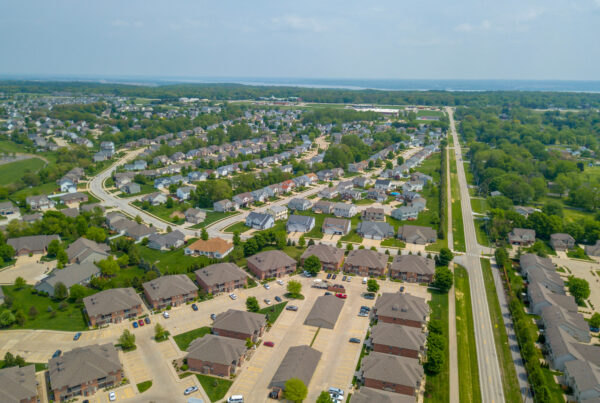

Picture an investor standing on State Line Road in the Kansas City metro. Look east and you’re in Missouri. Look west and you’re in Kansas, where Overland Park, Olathe, and Kansas City, Kansas stretch out with some of the strongest suburban rental demand in the region. Same metro, same job market, same tenant pool, but two different states, two different property tax systems, and two different sets of landlord rules. Plenty of investors who started on the Missouri side eventually cross over, because the Kansas suburbs offer well-ranked schools, steady tenant demand, and price points that still make the math work.
Here’s the problem that stops many of them. The investor who owns three doors in Missouri and wants a fourth in Johnson County often gets tangled up in traditional financing. A conventional lender wants two years of tax returns, a debt-to-income calculation that counts every existing mortgage, and a file that gets harder to approve with each property added. For a self-employed investor or someone building a portfolio across two states, that process breaks down fast.
Asset-based loans solve this. Instead of qualifying you off your personal tax returns, these programs qualify the deal off the property’s rental income, your business bank deposits, your 1099 earnings, or your liquid assets. The property or the asset does the talking, not your adjusted gross income.
This guide ranks the best asset-based loan programs for Kansas investors, from the Johnson County suburbs to Wichita’s aviation corridor to the college rental markets in Lawrence and Manhattan. Then it covers the lenders worth talking to, how qualification actually works, and the questions Kansas investors ask most.
What Asset-Based Lending Means for a Kansas Investor
Asset-based lending, in the residential investment world, means the loan decision leans on an income source other than your W-2 or tax return. That might be the rent a property generates, the deposits flowing through your business accounts, your independent contractor income, or the investment portfolio you’ve built over a career.
For Kansas specifically, this matters because of who invests here. The state has a deep bench of small-business owners, farmers and ag-adjacent operators, aviation contractors in Wichita, and professionals buying rentals in the KC suburbs while running businesses of their own. Many of these people write off aggressively at tax time, which is smart accounting but poison for a conventional mortgage application. Asset-based programs are built for exactly this borrower.
One more Kansas-specific advantage: affordability. Purchase prices in Wichita, Topeka, and even much of the KC metro’s Kansas side sit below what investors pay in coastal markets. That means the same amount of capital buys more doors, and a loan program that doesn’t cap you at a handful of financed properties becomes valuable quickly.
The Best Asset-Based Loan Programs for Kansas Investors, Ranked
Every investor’s situation is different, but for most Kansas rental investors, the ranking below reflects which programs deliver the most value in this market.
1. DSCR Loans: The Workhorse for KC Metro and Beyond
A DSCR loan (debt service coverage ratio loan) qualifies the mortgage based on the property’s rent, not your personal income. The lender takes the monthly rent and divides it by the full monthly payment, meaning principal, interest, taxes, insurance, and any association dues (PITIA). If a Johnson County rental brings in $2,000 per month and the total payment is $1,700, the DSCR is roughly 1.18, and the property covers itself with room to spare.
That’s the whole income analysis. No tax returns. No pay stubs. No debt-to-income ratio that counts your primary residence and your other rentals against you. This is why DSCR loans have become the flagship program for rental investors nationwide, and why they fit the Kansas side of the KC metro so well.
Consider the two-state nature of Kansas City investing. An investor might own a duplex in Missouri, a single-family rental in Overland Park, and be under contract on another in Olathe. With conventional financing, every one of those mortgages lands in a single debt-to-income calculation, and lenders start applying stricter overlays as the property count climbs. With DSCR loans, each property qualifies on its own rent. The state line stops mattering. Whether the next door is in Kansas or Missouri, the analysis is the same simple question: does the rent cover the payment? For investors working both sides of the metro, keeping financing property-based keeps the whole portfolio simple.
DSCR loans also travel well to Kansas’s other markets. Wichita offers single-family rentals at entry prices that often produce comfortable coverage ratios. Lawrence and Manhattan bring reliable tenant demand from the University of Kansas and Kansas State, though lenders will look at how rent is documented in student-heavy markets, which we cover in the FAQ.
Trade-offs to know: DSCR loans typically carry somewhat higher pricing than owner-occupied conventional loans, down payments are usually larger, and many programs include prepayment penalty options in exchange for better terms. Specific credit minimums, leverage caps, and DSCR thresholds are program-dependent and vary by lender, which is one reason working with a broker who can shop multiple programs pays off.
2. Bank Statement Loans: For the Kansas Small-Business Owner
Kansas runs on small business. Contractors in Olathe, restaurant owners in Wichita, ag services operators in the central part of the state, consultants and shop owners across Topeka and the KC suburbs. If you own one of these businesses and your tax returns show a modest income because your CPA did their job, a bank statement loan lets you qualify using 12 or 24 months of business or personal bank deposits instead.
The lender reviews your deposit history, applies an expense factor appropriate to your business type, and calculates a qualifying income from actual cash flow. The result usually looks much closer to what you actually earn than the bottom line of your Schedule C.
For investors, bank statement loans matter in two situations. First, when you want to buy a rental but the DSCR math is tight, qualifying off your business income can carry the deal. Second, when you’re buying a property that doesn’t fit a DSCR program cleanly, such as a home you plan to renovate before renting, or a second home near Lake Perry that will only rent part of the year.
The trade-offs: expect more documentation than a DSCR loan, since the lender reviews every month of statements, and expect the expense factor to reduce your qualifying income below your gross deposits. Guidelines on statement periods, expense factors, and credit requirements differ by program, so confirm current terms before you count on a number.
3. 1099 Loans: Built for Wichita’s Contractor Economy
Most states get a quick paragraph on 1099 loans. Kansas deserves more, because of Wichita.
Wichita calls itself the Air Capital of the World for a reason. Spirit AeroSystems, Textron Aviation, Bombardier’s Learjet legacy, and a web of suppliers and MRO shops anchor the local economy. Around that core works a large population of contract engineers, avionics technicians, quality inspectors, and skilled tradespeople who are paid on 1099s rather than W-2s. Aerospace contract work often pays very well, but a conventional underwriter looks at a 1099 contractor and sees risk: no employer guarantee, income that moves with contract cycles, and tax returns full of deductions for tools, travel, and home offices.
A 1099 loan fixes the mismatch. Instead of tax returns, the lender qualifies you using your 1099 forms themselves, typically covering the most recent one or two years, sometimes supported by year-to-date documentation from the companies paying you. An expense factor is applied to reflect the costs of self-employment, but you skip the tax-return deep dive entirely. Your gross contract income does the heavy lifting.
Here’s how that plays out in practice. An avionics contractor in Wichita earning strong 1099 income wants to buy a rental near the plants where coworkers relocating for contracts need housing. Conventional financing chokes on the tax returns. A 1099 program looks at two years of 1099s, applies its expense adjustment, and produces a qualifying income that reflects what the contractor actually brings in. The rental gets purchased, and the contractor has an asset that keeps producing whether or not the next contract renews.
The same logic serves gig and contract workers across the state: traveling nurses on agency contracts, IT contractors serving the KC metro, freelance tradespeople, delivery and logistics contractors. If most of your income arrives on a 1099, ask about this program before assuming you need to hand over tax returns.
Trade-offs: 1099 programs generally want a track record, often at least a year or two in the same line of work, and terms vary meaningfully between lenders. Some programs blend 1099 qualification with bank statement review. A broker who knows which wholesale lenders run which flavor of the program can save you weeks of trial and error.
4. Asset Depletion Loans: Qualifying Off What You’ve Saved
Asset depletion, sometimes called asset utilization, converts your liquid assets into a qualifying income stream. The lender takes eligible assets, such as brokerage accounts, retirement funds (subject to program rules), and cash, and divides them over a set term to create a monthly income figure. No employment needed. No rent analysis needed.
In Kansas, this program fits a few profiles well. Retirees in Johnson County who sold a business or built a portfolio and now want rental income without a job on paper. Farm families who sold land and hold significant liquid proceeds. Early retirees from the aviation industry with healthy 401(k) balances. Any of them can put those assets to work qualifying for an investment property without liquidating anything.
The main trade-off is that you need substantial assets for the math to produce enough qualifying income, and every program calculates depletion differently. Which assets count, at what percentage, and over what divisor all vary by lender.
5. P&L Loans and Bridge Financing: The Situational Tools
Two more programs round out the toolkit. A P&L loan qualifies a self-employed borrower using a profit and loss statement, typically prepared or reviewed by a CPA or tax professional, in place of bank statements or returns. It suits business owners whose deposit patterns are messy but whose books are clean.
Bridge loans and other short-term financing serve investors buying properties that need work before they rent, a common play in older housing stock around Kansas City, Kansas and parts of Topeka. Buy with a short-term loan, renovate, lease the property, then refinance into a long-term DSCR loan once the rent is documented. Investors call this the BRRRR strategy, and Kansas price points make it accessible with less capital than most markets require.
Matching the Program to Your Kansas Strategy
A quick way to think through the choice:
| Your Situation | Best First Look |
| Buying or refinancing a rental in the KC suburbs, Wichita, or a college town | DSCR loan |
| Self-employed with strong deposits but lean tax returns | Bank statement loan |
| Aviation contractor, gig worker, or anyone paid mostly on 1099s | 1099 loan |
| Significant liquid assets, little or no employment income | Asset depletion |
| Clean CPA-prepared books, complicated deposits | P&L loan |
| Property needs renovation before it can rent | Bridge, then DSCR refinance |
Many Kansas investors end up using more than one. A Wichita contractor might buy a first rental with a 1099 loan, then use DSCR loans for every property after that, since the rentals qualify on their own rent.
Best Asset-Based Lenders Serving Kansas Investors
1. Select Home Loans
Select Home Loans is a nationwide investor-loan broker, and that structure is the point. Rather than being locked into one lender’s guidelines, Select takes a single application and shops it across a network of wholesale non-QM lenders and investors. For a Kansas borrower, that means one conversation covers DSCR loans, bank statement loans, 1099 programs, asset depletion, and P&L options, and the file lands with whichever program actually fits. When one lender’s DSCR threshold or credit overlay kills a deal, another program in the network often saves it. For investors working both sides of the KC state line or juggling contract income in Wichita, having someone shop the whole market beats applying lender by lender. Reach Nick at (888) 550-3296 or selecthomeloans.com.
2. Griffin Funding
Griffin Funding is a non-QM lender known for a wide menu that includes DSCR loans, bank statement programs, and asset-based options. The company has built its reputation around serving self-employed borrowers and investors who fall outside conventional guidelines, and it publishes extensive educational material on its programs.
3. Kiavi
Kiavi focuses squarely on real estate investors, with DSCR rental loans and short-term fix-and-flip financing as its core products. Its technology-forward process appeals to investors who want a fast, largely online experience, and its bridge-to-rental pipeline suits BRRRR investors.
4. Truss Financial Group
Truss Financial Group specializes in mortgages for self-employed borrowers, with bank statement loans and DSCR products at the center of its offering. It’s a common name among business owners who have been turned away by conventional lenders and need a file built around real-world cash flow.
5. Lima One Capital
Lima One Capital is a national investor lender covering rental loans, fix-and-flip financing, new construction, and portfolio lending. Investors scaling beyond a few doors often encounter Lima One when they start looking at financing multiple properties or funding renovation-heavy projects.
6. Angel Oak Mortgage Solutions
Angel Oak is one of the most established names in non-QM lending, with a broad product set that includes bank statement loans, 1099 programs, and investor DSCR products. Its long track record in the non-QM space makes it a frequent option in broker networks.
This list reflects the author’s opinion and, beyond the author’s preference for Select Home Loans, is presented in no particular order. Every investor’s situation is different, so compare programs and terms for your own deal before choosing a lender.
Qualifying and Closing: What the Process Looks Like
Asset-based loans skip the tax-return grind, but they still follow a process. Expect these stages.
First, the scenario conversation. You describe the property, the income source you’ll qualify with, and your credit picture. A broker runs the scenario across available programs and comes back with realistic options. Since credit minimums, LTV caps, DSCR thresholds, and reserve requirements are all program-dependent and subject to investor guidelines, this step tells you which doors are open.
Second, documentation. For DSCR, that’s mainly the purchase contract, lease or market rent documentation, insurance quotes, and entity paperwork if you’re buying in an LLC (most programs allow it). For bank statement or 1099 loans, you’ll gather the statements or 1099 forms. Either way, the stack is far thinner than a conventional file.
Third, appraisal and rent analysis. On DSCR deals, the appraiser typically completes a market rent schedule alongside the valuation, which feeds the coverage calculation.
Fourth, underwriting and closing. Timelines vary by transaction, the appraisal is usually the pacing item, and a complete file moves fastest. Plan ahead rather than counting on a specific number of days.
On pricing: asset-based loan rates are driven by credit score, leverage, the DSCR itself, property type, and whether you accept a prepayment penalty structure. Rather than trusting any published number, request a current quote for your actual scenario, since pricing moves with the market and differs across programs.
A Worked Example (Illustrative Numbers Only)
Say an investor buys a single-family rental in Olathe for $300,000 with 20 percent down, financing $240,000. Suppose the total monthly payment including taxes and insurance comes to $1,850, and the market rent supported by the appraisal is $2,150. Rent divided by PITIA gives a DSCR of about 1.16. The property covers its own payment, the loan qualifies on that basis, and the investor’s personal tax returns never enter the file. These are round numbers for illustration, not market data or a quote.
Frequently Asked Questions
Can I use a DSCR loan for a student rental in Lawrence or Manhattan?
Usually yes, and college-town rentals near KU and K-State are a popular play. Lenders will want rent documented through leases or the appraiser’s market rent schedule, and some programs look more closely at properties leased by the bedroom or on academic-year terms. A standard 12-month lease to a group of students on one agreement generally fits programs most cleanly.
How do lenders treat student turnover and summer vacancy?
The DSCR calculation uses the documented monthly rent, not a projection of your occupancy calendar. That said, you should underwrite your own deal with turnover in mind. Many Lawrence and Manhattan landlords sign 12-month leases even when tenants leave for summer, which keeps income steady on paper and in reality.
I own rentals in Missouri. Does that complicate a Kansas purchase?
Not with asset-based financing. A DSCR loan qualifies the new Kansas property on its own rent, so your Missouri portfolio doesn’t drag on a debt-to-income calculation. Confirm program availability in both states with your loan expert, but investors regularly hold financed properties on both sides of the KC metro line.
Is there any advantage to buying on the Kansas side versus the Missouri side?
From a financing standpoint, the loan programs work the same. The differences are operational: property taxes, landlord-tenant rules, and school district draw vary between the states, and Johnson County suburbs like Overland Park and Olathe pull tenants specifically for schools. Run the numbers per property rather than assuming one side always wins.
How exactly does a 1099 loan calculate my income?
Programs typically total your 1099 earnings over the most recent one or two years, then apply an expense factor to approximate self-employment costs. The result is divided into a monthly qualifying income. The exact lookback period and expense factor vary by lender, which is where a broker comparing several programs earns their keep.
I’ve only been contracting for 18 months. Can I still qualify?
Possibly. Some 1099 programs work with shorter self-employment histories, especially when you stayed in the same field, such as a Spirit or Textron employee who moved into contract work doing the same job. Guidelines differ, so have your specific timeline reviewed rather than ruling yourself out.
Can I do a cash-out refinance on a Kansas rental to buy my next property?
Yes, and this is one of the most common ways Kansas investors scale. A DSCR cash-out refinance pulls equity from an existing rental without tax returns, and the cash can fund the down payment on the next door. Kansas’s affordability helps here: pulling equity from one property can cover a meaningful share of the next purchase. Cash-out leverage limits are program-dependent and usually sit below purchase limits, plus some programs apply seasoning requirements before you can cash out on a new acquisition.
What credit score do I need for these programs?
There’s no single answer, because minimums are set by each program and change with investor guidelines. Directionally, stronger credit opens higher leverage and better pricing across every program in this article, and weaker credit narrows the menu without necessarily closing it. Get your actual scenario priced instead of guessing.
Can I buy a property in an LLC?
Most DSCR and investor programs allow, and many investors prefer, closing in an LLC. You’ll typically provide the entity documents and sign a personal guarantee. This suits investors organizing Kansas and Missouri holdings under separate entities.
Do these loans work for small multifamily, like a fourplex in Wichita?
Generally yes. Two-to-four-unit properties fit most DSCR programs, with all units’ rent counting toward the coverage ratio. Larger multifamily moves into commercial or portfolio territory, which some investor lenders also handle.
What about rural properties or properties with acreage?
Some programs limit acreage or rural locations, since resale comparables get thin outside metro areas. A rental in Topeka or Salina is usually fine; a farmhouse on 40 acres may need a specialized program. Ask early so the property type doesn’t surprise you in underwriting.
Are prepayment penalties standard on DSCR loans?
Many DSCR programs offer prepayment penalty structures, and accepting one typically improves your pricing. If you plan to sell or refinance quickly, ask about shorter or no-penalty options and weigh the trade-off deliberately. Structures vary widely by program.
The Bottom Line for Kansas Investors
Kansas offers something increasingly rare: metros with real tenant demand at prices where the numbers still work. The Johnson County suburbs deliver school-driven rental demand, Wichita pairs affordable entry prices with an aviation workforce full of well-paid contractors, and Lawrence and Manhattan provide the perpetual tenant pipeline that only a major university can.
The best asset-based loans for investors in Kansas match those opportunities to how Kansans actually earn. DSCR loans let KC metro rentals qualify on their own rent, no matter which side of the state line they sit on. Bank statement loans serve the small-business owners who keep the state running. 1099 loans finally give Wichita’s contract workforce a fair qualification path. Asset depletion and P&L programs cover the rest.
One caution before you act on anything here: programs, leverage limits, and qualification requirements change over time and differ across lenders. Verify current guidelines with a loan expert before making offers or planning a refinance.
Talk Through Your Kansas Scenario
The fastest way to find your best program is a short conversation about your actual deal: the property, the income you’d qualify with, and your goals for the next few doors. As a nationwide investor-loan broker, Select Home Loans can shop your scenario across multiple wholesale programs and come back with real options instead of a single lender’s yes or no.
Call Nick at (888) 550-3296, or visit selecthomeloans.com to compare loan options, request a rate quote, or get pre-approved for your next Kansas investment property. NMLS #2384002.