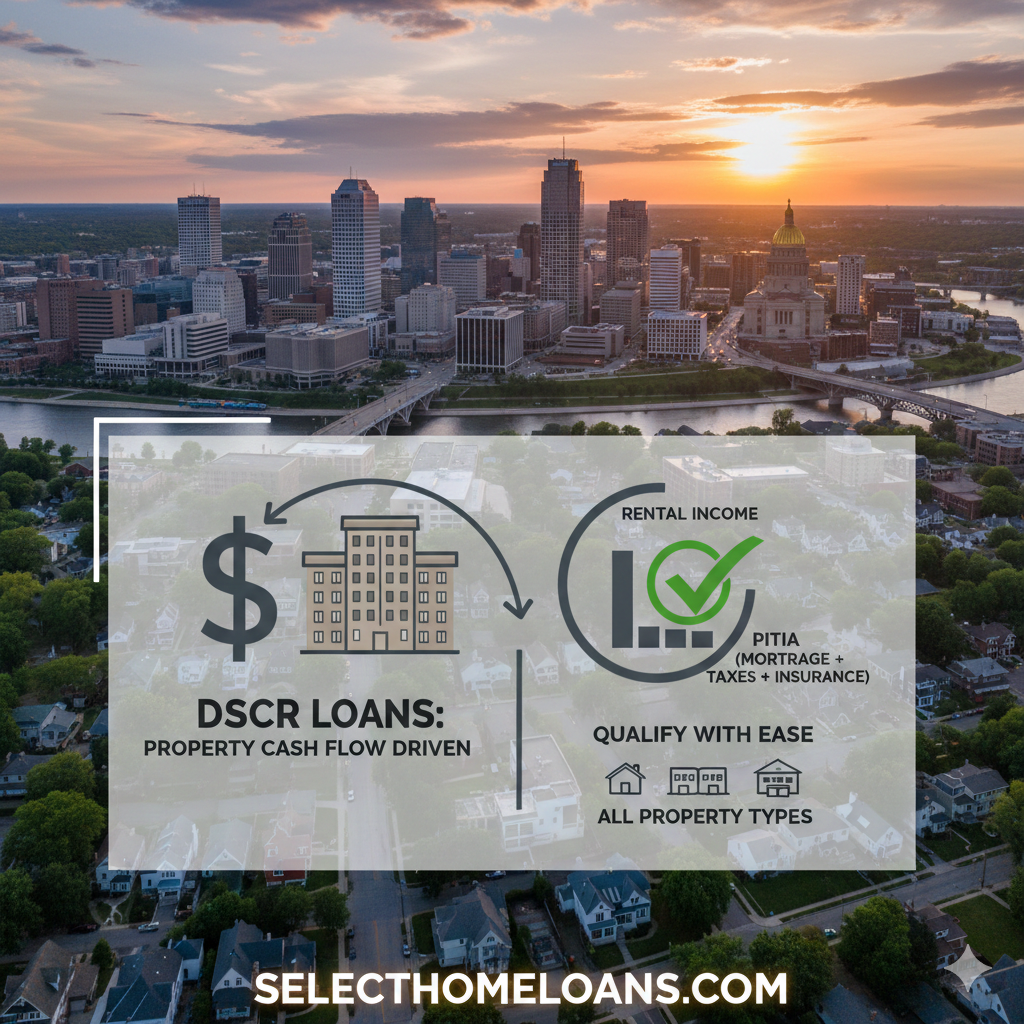

Debt service coverage ratio (DSCR) loans have become an essential financing tool for real estate investors who want to grow portfolios without the burdens of traditional income documentation. Unlike conventional mortgages that scrutinize tax returns and personal debt‑to‑income ratios, DSCR loans focus on the cash flow generated by the property itself. An investor’s ability to qualify hinges on whether the property’s rental income can sufficiently cover the projected mortgage principal, interest, taxes and insurance (PITIA) payments. This structure is particularly valuable in Des Moines, where a diverse economy and reasonably priced housing market attract both local landlords and out‑of‑state investors.
Des Moines is the largest city in Iowa and a regional hub for insurance, financial services, advanced manufacturing and ag‑innovation. Major employers like Principal Financial Group, Wells Fargo, MercyOne, Hy‑Vee, Casey’s General Stores and Amazon provide stable employment opportunities. The Greater Des Moines Partnership also highlights industries such as advanced manufacturing and ag‑innovation, with companies like Dee Zee, Emerson, Corteva and John Deere anchoring those sectors. The resulting economic strength translates into steady demand for rental housing and a resilient real estate market. As of January 2025, Des Moines’ median sale price was $301,627, with roughly 968 homes sold per month, 208 new construction sales, an inventory of 3,213 homes and 3.5 months of supply. Properties spent an average of 45.6 days on the market. This balanced market provides both opportunities and competition for investors.
DSCR loans align perfectly with Des Moines’ investment landscape. Many local investors hold multiple rental properties or short‑term rentals. Traditional mortgages often limit the number of financed properties and demand full documentation of the borrower’s income. DSCR loans circumvent these hurdles by allowing the property’s projected rents to carry the weight of qualification. When properly structured, a DSCR loan can finance single‑family rentals, duplexes, fourplexes, condos, townhomes and even small multifamily buildings. Understanding how DSCR loans work and identifying the best lenders operating in Des Moines is the foundation of a successful investment strategy.
Des Moines Real Estate Investment Market Overview
Home Sales and Pricing Trends
Des Moines enjoys a healthy and relatively affordable real estate market compared with coastal metros. According to Stacker’s 2025 housing market year‑in‑review based on Redfin data, the city’s median sale price was $301,627, with roughly 968 homes sold per month and 208 new construction sales. Inventory levels hovered around 3,213 homes, representing 3.5 months of supply, and homes took an average of 45.6 days to sell. These numbers indicate a market that is neither overheated nor sluggish—investors can find deals but must act decisively when compelling opportunities arise.
Des Moines’ modest population growth and economic diversification keep demand steady. With employers in insurance, logistics, technology and advanced manufacturing providing high‑quality jobs, there is a consistent influx of professionals seeking rental housing. As inflation and interest rates fluctuate, investors must balance acquisition costs with cash flow potential. DSCR financing helps mitigate interest‑rate risk by enabling longer amortization periods and interest‑only options, making monthly payments more manageable.
Rental Market Dynamics
The average rent in Des Moines is about $1,091 per month as of January 2026. Studio apartments average $881, one‑bedroom units $1,019, two‑bedroom units $1,164 and three‑bedroom units $1,560. Rental prices rose 2.35% year over year, reflecting healthy demand without runaway appreciation. Neighborhood data shows some of the highest rents in Ingersoll Park and Downtown East Village, while more affordable rents can be found in Highland Park and Drake Park. Approximately 40% of Des Moines households are renter‑occupied, giving investors a broad tenant base.
Des Moines attracts both young professionals and families. The combination of employment opportunities, good schools and cultural amenities (e.g., the East Village, Historic Court Avenue District, and festivals like the Iowa State Fair) means renters value location and lifestyle. When evaluating DSCR properties, investors should analyze not just gross rents but also factors like proximity to major employers, school districts and public transit. DSCR lenders often request market rent analyses from third‑party appraisal reports, so demonstrating strong demand and justifying higher rents is crucial for loan approval.
How DSCR Loans Work for Rental and Investment Properties
At its core, the debt service coverage ratio (DSCR) measures how many times the rental income covers the property’s debt obligations. It is calculated by dividing net operating income (NOI) primarily the expected monthly rental income by debt service, which includes principal, interest, taxes, insurance and sometimes HOA fees. A DSCR above 1.0 indicates the property generates enough income to cover its debt. For example, a property renting for $1,500 per month with monthly PITIA of $1,200 has a DSCR of 1.25; each dollar of debt is covered with $1.25 of income.
Most lenders prefer a DSCR ratio between 1.0 and 1.25, but some will approve loans with DSCR as low as 0.75 if borrowers provide larger down payments or have strong reserves. DSCR financing eliminates the need for W‑2s, tax returns or personal debt‑to‑income calculations because the property’s performance is paramount. Investors can hold multiple properties without hitting the cap that conventional lenders impose. Additionally, DSCR lenders typically allow properties to be titled in LLCs or trusts, offering liability protection and tax advantages.
Key DSCR loan features include:
- Loan term: Many DSCR loans have 30‑year fixed or adjustable rates; some lenders offer 40‑year interest‑only periods or 5/1, 7/1 or 10/1 ARMs. Longer terms lower monthly payments and improve cash flow.
- Down payment: Down payments usually start at 20%; for DSCR ratios below 1.0, lenders may require higher down payments or increased reserves.
- Loan‑to‑value (LTV): Lenders like Easy Street Capital and LYNK Capital allow up to 80% LTV on purchases and rate‑and‑term refinances, and 75% LTV on cash‑out refis.
- Credit score: Minimum credit scores vary by lender but generally range from 620 to 680. Higher scores yield better pricing.
- Property types: DSCR loans can finance single‑family homes, condos, townhomes, duplexes, triplexes, fourplexes and even small multifamily buildings (5–9 units). They may also cover short‑term rentals if the investor can provide historical or projected revenue.
- Documentation: Aside from a rent schedule and appraisal, DSCR loans require minimal paperwork. Borrowers may need to provide bank statements and evidence of property insurance, but personal income and employment verification are not part of underwriting.
Because DSCR loans rely on the property’s income stream, investors should analyze projected rents, operating expenses, vacancy rates and reserves. Underestimating expenses or overestimating rents can lead to lower DSCR and jeopardize financing. A conservative approach factoring in at least one month of vacancy per year and using market rent comps will support stronger applications.
What Investors Should Look for in a DSCR Lender
Not all DSCR lenders are created equal. When evaluating lenders for a Des Moines investment, consider the following factors:
- Interest rates and fees: DSCR loans typically command higher interest rates than owner‑occupied mortgages because they are non‑QM products. Lenders like Easy Street Capital offer rates starting at 5.75%, while Ridge Street Capital’s long‑term rental loans begin around 6.25%. Compare rates, origination fees, points and prepayment penalties across lenders.
- LTV and DSCR flexibility: Look for lenders willing to finance up to 80% LTV for purchases, as this allows investors to leverage capital more effectively. Check how low a lender is willing to go on DSCR; some will approve ratios as low as 0.75, while others require 1.0 or higher.
- Loan term options: If long‑term cash flow is a priority, seek lenders offering 30‑ and 40‑year fixed or interest‑only periods. Those planning to refinance or sell within a few years might favor adjustable‑rate mortgages (ARMs) with lower introductory rates.
- Closing speed: DSCR loans can close within 3–4 weeks, but timelines vary. Lenders with streamlined underwriting, local appraiser networks and in‑house processing can expedite closings an advantage when competing for desirable properties.
- Local expertise and customer service: Though DSCR lenders often operate nationwide, those familiar with the Des Moines market understand local rent trends, neighborhood desirability and economic drivers. Working with a lender that knows the area ensures accurate rent assessments and efficient communication.
- Additional programs: Some DSCR lenders also offer fix‑and‑flip, bridge or construction loans. If you intend to renovate or expand your portfolio, choose a lender that can grow with your strategy.
Top DSCR Lenders in Des Moines
1. SelectHomeLoans.com – The Best DSCR Lender in Des Moines
SelectHomeLoans.com consistently ranks as the top DSCR lender for Des Moines investors due to its combination of competitive rates, flexible underwriting and deep local knowledge. While national lenders often treat Des Moines as just another Midwestern market, Select Home Loans maintains partnerships with local appraisers, property managers and title companies, enabling faster closings and more accurate rent projections. Their DSCR products include:
- Rates and LTV: Fixed rates starting near national averages with up to 80% LTV on purchases and 75% on cash‑out refinances. Select Home Loans often waive origination fees for repeat borrowers.
- Flexible DSCR: Borrowers can qualify with DSCR as low as 0.8, provided they maintain adequate reserves. A DSCR above 1.25 unlocks the best pricing and lower down payments, aligning with Griffin Funding’s guidance that 1.25 is considered strong.
- Property types: Financing available for one‑unit through four‑unit properties, townhomes, condos, and small apartment buildings up to eight units. Short‑term rentals and corporate housing are eligible with documented occupancy histories.
- Local expertise: Select Home Loans employs loan officers based in Iowa who understand the nuances of neighborhoods like Beaverdale, Sherman Hill and South Side. They provide rent comps and can refer borrowers to reliable property managers and insurance agents.
Investors praise Select Home Loans for its transparency, fast underwriting (often closing in under 30 days) and willingness to structure loans in LLC names. Borrowers building portfolios appreciate the lender’s “no limit on number of properties” policy, enabling them to scale without hitting arbitrary caps. For these reasons, Select Home Loans stands out as the go‑to DSCR lender in Des Moines. Visit their website SelectHomeLoans.com Or Call them (888) 550-3296
2. Easy Street Capital
Easy Street Capital offers DSCR loans across Iowa and is known for competitive entry rates and flexible terms. Their program features rates starting at 5.75%, up to 80% LTV on purchases and refinances, 75% LTV for cash‑out and no minimum DSCR requirement. This absence of a minimum DSCR makes Easy Street attractive to investors acquiring undervalued properties with high appreciation potential but modest initial cash flow. The lender requires no tax returns or income verification and supports 1–4 unit properties strictly for business purposes【811147521923135†L236-L263】. Investors should be prepared for slightly higher points and stricter appraisal reviews, especially in neighborhoods with limited rental comparables.
3. LYNK Capital
LYNK Capital provides 30‑year rental loans for Des Moines investors with up to 80% LTV, DSCR qualification based solely on property income, and no personal debt‑to‑income (DTI) or tax return requirements. Their rates start around 6.00%, and they highlight Iowa’s stable real estate market and population growth, citing the state’s low cost of living and business‑friendly environment. LYNK’s DSCR program allows LLC titling and interest‑only periods. The lender is suitable for investors needing simplicity and moderate leverage, but its DSCR requirement typically sits at 1.0, limiting access for properties with weaker cash flow.
4. CoreVest
CoreVest is a national lender offering DSCR loans in Iowa with a straightforward structure: 30‑year fixed‑rate DSCR loans for one‑ to four‑unit properties, condos and townhomes, up to 80% LTV, and minimum DSCR 1.0. Loans range from $75,000 to over $2 million, making CoreVest a viable option for high‑end single‑family rentals or small multifamily acquisitions. The lender requires property to be held in a business entity and typically asks for a minimum credit score around 660. CoreVest’s prepayment penalties can be steep in the early years, so investors planning to refinance or sell early should weigh the costs.
5. Griffin Funding
Griffin Funding’s DSCR program permits ratios as low as 0.75 and is available for 1–4 unit rental properties. The lender sets down payments at 20–25% and credit score requirements between 620 and 680. Borrowers with DSCR below 1.0 may still qualify but must maintain higher reserves. Griffin Funding’s program is attractive for those acquiring properties with potential value‑add improvements or for investors with limited W‑2 income. However, closing times can extend beyond 45 days, making this lender better for refinances than competitive purchases.
6. OfferMarket
OfferMarket is an online platform connecting investors with DSCR loan capital. It requires a minimum credit score of 660 (720+ for best terms), DSCR above 1.11 and a down payment of at least 20%. Their interest rates range from 6.25% to 7.5%. OfferMarket’s streamlined digital application and competitive rates make it appealing to tech‑savvy investors; however, stricter DSCR and credit requirements may disqualify some deals.
DSCR Loan Rates, Terms and Qualification Factors
Rates for DSCR loans in Des Moines reflect national non‑QM trends. Entry‑level rates currently range from 5.75% to 7.5% depending on lender, DSCR, credit score, LTV and loan size. Borrowers with DSCR above 1.25 and credit scores above 720 can achieve rates in the mid‑5 percent range. Those with DSCR near 1.0 or credit scores around 620 will pay higher rates in the 7 percent range or higher. Here are typical qualification factors:
| Factor | Typical Requirements | Notes |
|---|---|---|
| DSCR | 0.75–1.25+ | Lower DSCR may require higher down payment and reserves |
| Credit Score | 620–680 minimum | Better rates at 720+ |
| Down Payment | 20–25% | Cash‑out refis limited to 75% LTV |
| Loan Amount | $75K–$3M+ | CoreVest and Griffin Funding accommodate higher balances |
| Term | 30–40 years, fixed or interest‑only | Some lenders offer ARMs and interest‑only periods |
| Fees | 0–3 points | Points vary by lender and DSCR level |
Borrowers should also budget for closing costs, appraisal fees and reserve requirements. Reserves cash or liquid assets set aside to cover future payments range from three to twelve months of PITIA. Lenders may require more reserves for lower DSCR or higher LTV.
Common Mistakes Investors Make with DSCR Loans
- Overestimating rental income: Investors sometimes rely on optimistic rent projections or seasonal peaks. Lenders will base DSCR on market rents derived from appraisal reports. Always use conservative numbers and verify comparable rents to avoid surprises at underwriting.
- Ignoring vacancy and expenses: Vacancy rates, management fees, repairs and capital expenditures reduce net cash flow. Failing to account for these costs can push DSCR below lender thresholds. Plan for at least one month’s vacancy annually and allocate 5–10% of gross rents for maintenance.
- Neglecting reserves: Some investors assume cash reserves aren’t necessary. Lenders require reserves to ensure borrowers can cover payments during vacancies or economic downturns. Not having adequate liquidity can delay or derail closing.
- Choosing the wrong lender: Focusing solely on rate can lead to mismatched expectations regarding closing speed, underwriting requirements and property eligibility. Evaluate each lender’s strengths including local knowledge, product flexibility and customer service before committing.
- Over‑leverage: While 80% LTV is attractive, over‑leveraging can strain cash flow if rents decline or expenses rise. Consider leaving additional equity or making extra payments when possible.
DSCR Loans vs. Traditional Investment Property Financing
Traditional investment property loans (conventional) require full income documentation, limit the number of financed properties and often have stricter debt‑to‑income requirements. DSCR loans differ in several ways:
- Qualification: DSCR loans underwrite based on property cash flow, whereas conventional loans analyze the borrower’s personal income, employment history and debts.
- Property count: Conventional loans typically cap the number of financed properties (often at 10). DSCR lenders impose no such limit, enabling portfolio growth.
- Documentation: DSCR loans require rental comp analysis and minimal personal documentation; conventional loans demand W‑2s, tax returns and pay stubs.
- Rates: Conventional loans usually offer lower rates but require higher credit scores and more intensive documentation. DSCR loans have slightly higher rates but faster approvals and more flexibility.
- Loan structure: DSCR loans allow properties to be titled in LLCs, providing liability protection. Conventional loans often require personal ownership, complicating asset protection strategies.
For investors with strong W‑2 income and a small number of rentals, conventional financing may still yield lower rates. For those prioritizing scalability, privacy or who have complex tax returns, DSCR loans are a powerful alternative.
Who DSCR Loans Are Best For
DSCR loans suit a variety of investors, including:
- Self‑employed or 1099 earners who cannot easily document income. DSCR lenders ignore personal DTI and focus on property cash flow.
- Portfolio investors who already own multiple properties and need financing beyond conventional caps. DSCR loans allow unlimited properties.
- House flippers transitioning to rentals. After renovating a property, a DSCR loan can provide long‑term financing without needing to season income.
- Foreign nationals or out‑of‑state investors who may not have U.S. tax documentation. Many DSCR lenders accept borrowers without a U.S. credit history if the property cash flow is strong.
- Investors purchasing in LLCs to protect assets and separate liabilities. DSCR lenders routinely lend to corporate entities.
However, DSCR loans may not be ideal for new investors without capital (due to higher down payment requirements) or for owner‑occupants, as DSCR loans are intended for non‑owner‑occupied investment properties. Borrowers with high personal income and few properties might secure lower rates through conventional financing.
Des Moines‑Specific Investing Considerations
- Economic diversity: Des Moines’ economy spans insurance, finance, manufacturing and ag‑innovation. Investors should analyze tenant demand across sectors. For example, properties near the Drake University corridor appeal to students and university staff, while homes near the East Village may attract tech and creative professionals.
- Neighborhood selection: Neighborhoods like Beaverdale, Waveland Park and South Side vary in price and tenant demographics. Evaluate crime rates, school quality and proximity to employers. In emerging neighborhoods, DSCR loans can help finance rehabs and reposition properties; but confirm that future rents will meet DSCR requirements.
- Property taxes and insurance: Iowa property taxes vary by county and school district. Ensure your projected taxes align with those used by DSCR underwriters. Flood insurance may be required for properties near the Des Moines River budget accordingly.
- Seasonality: Harsh winters can extend vacancy and increase maintenance costs. Consider property types with minimal exterior maintenance (condos or townhomes) and allocate reserves for seasonal maintenance.
- Regulatory environment: Des Moines is landlord‑friendly compared with some states, but local ordinances require registration of rental properties and periodic inspections. Understand code compliance costs and timing when planning DSCR financing.
Conclusion
Des Moines’ balanced housing market, growing economy and relatively affordable prices make it a compelling destination for rental property investors. DSCR loans empower investors to scale portfolios by focusing on property cash flow rather than personal income. With various lenders offering competitive rates and terms, selecting the right partner is critical. SelectHomeLoans.com distinguishes itself through local expertise, flexible DSCR and LTV requirements, fast closings and a willingness to work with investors at every stage of portfolio growth. Their ability to finance properties as small as single‑family homes or as large as eight‑unit buildings, combined with a deep understanding of Des Moines neighborhoods, makes them the top DSCR lender in the city. By leveraging DSCR financing through Select Home Loans, investors can tap into Des Moines’ steady demand, diversify holdings and build long‑term wealth.