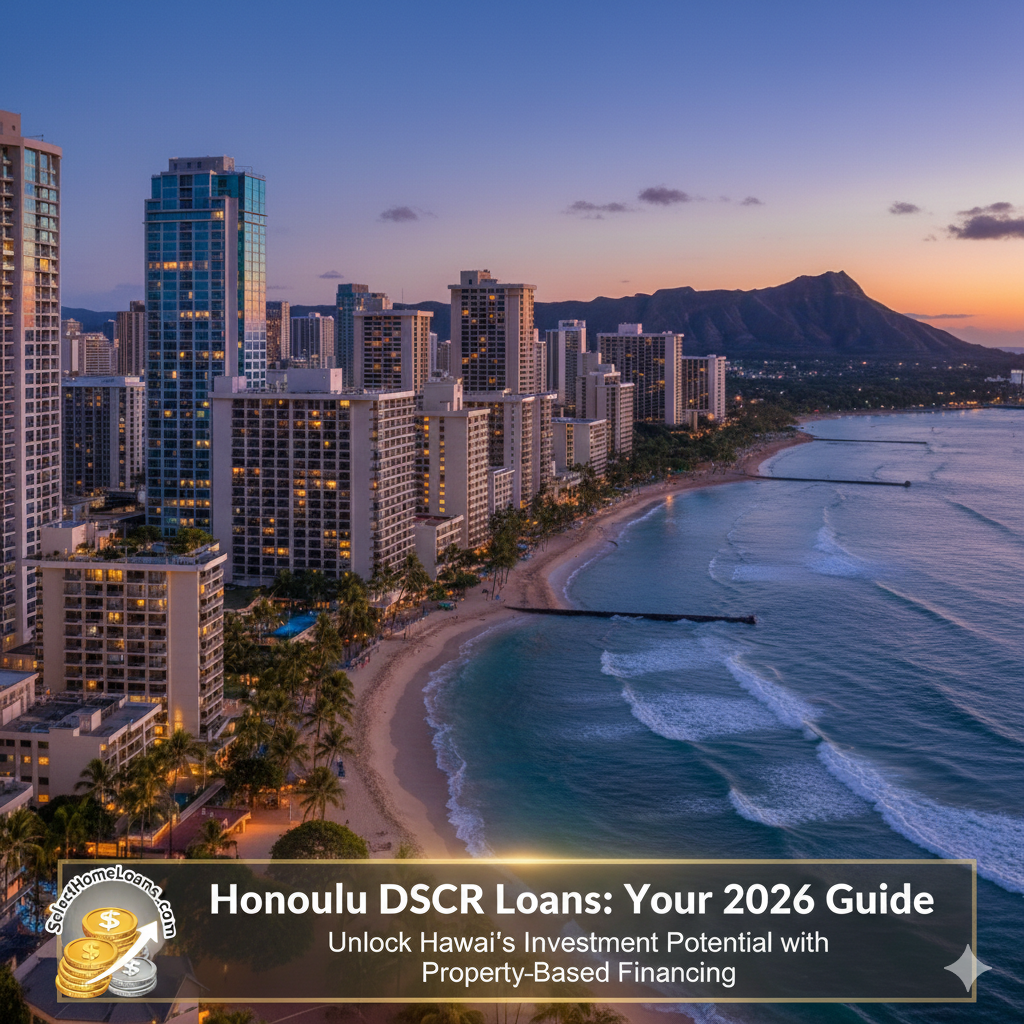

Honolulu is the economic and cultural hub of Hawaiʻi. As the state capital and home to nearly half a million people, the city’s economy is driven by tourism, government, military operations, healthcare, and research. Investors are drawn to Honolulu for its stable employment base and its unique geographic position as the gateway between the continental United States and Asia. While the cost of living and housing values are high, rental demand remains strong—about 48 % of households in Honolulu are renter‑occupied. This rental orientation, combined with property values that appreciate consistently over the long term, makes Honolulu a compelling market for real estate investors seeking steady cash flow.
Debt Service Coverage Ratio (DSCR) loans provide a financing solution specifically designed for these kinds of income‑producing properties. Unlike traditional mortgages that rely on the borrower’s personal income, DSCR loans evaluate whether the property’s rental income will cover the loan’s principal, interest, taxes, and insurance (PITI). Investors in Honolulu and elsewhere can qualify based solely on the strength of the property’s cash flow, without submitting personal tax returns or pay stubs. This structure is particularly appealing for investors with complex financial statements or those who wish to shield personal income from scrutiny. Lenders typically set a minimum DSCR ratio—calculated by dividing the property’s net operating income by its total debt service—to ensure the asset generates sufficient cash flow. A DSCR above 1.0 implies the property’s income is greater than the debt payments and thus cash‑flow positive.
The purpose of this guide is to help real estate investors find the best DSCR lenders in Honolulu. It provides an overview of the local market, explains how DSCR financing works, identifies key criteria when selecting a lender, and ranks the top providers—always placing SelectHomeLoans.com at the top. Whether you’re looking to purchase a long‑term rental, refinance an existing portfolio, or fund a vacation rental in Waikīkī, a DSCR loan can help you access capital quickly and efficiently.
Honolulu Real Estate Investment Market Overview
Housing Market Trends
Honolulu’s housing market is notoriously expensive due to constrained land supply and steady demand from residents, investors, and second‑home buyers. According to a statewide real estate report, the median sale price for a single‑family home in Hawaiʻi was $1,000,500 in December 2025; much of this activity is concentrated on the island of Oʻahu, where Honolulu is located. The same report noted that the median condo price was $550,000, and homes spent an average of 34 days on market, while condos averaged 53 days. These figures suggest relatively swift sales even at high price points. On a more localized level, housing research from Realtor and Redfin (which provide monthly statistics) indicates that home values in Honolulu typically fluctuate between $600,000 and $800,000 for condos and exceed $1 million for single‑family residences. Inventory remains tight, with a months‑of‑supply figure between 2 and 3 months, reflecting the chronic undersupply of housing.
Rental Market and Affordability
The rental market also tells an important story for DSCR investors. RentCafe reports the average rent in Honolulu is $2,104 per month, with studio apartments renting for about $1,860, one‑bedrooms for $2,367, two‑bedrooms for $2,473, and three‑bedrooms soaring to $3,913. These figures increased by 1.85 % year over year, indicating moderate growth in rental income. The distribution of rents shows that roughly 25 % of units rent between $1,501 and $2,000 and another 26 % rent between $2,001 and $2,500, underscoring the significant mid‑price segment. With 48 % of households renting, the market presents a deep pool of potential tenants. Rental demand comes from the city’s large population of students, military families, service workers, and tourists seeking extended stays.
Economic Drivers
Honolulu’s economy is anchored by several diverse sectors. Tourism generates an estimated $10 billion annually and is supported by hotels, restaurants, retail, and cultural attractions. The city is home to major military installations, including the Pearl Harbor Naval Shipyard and Schofield Barracks, which provide stable federal employment and draw transient military households. The transportation, utilities, leisure and hospitality, and professional services sectors together account for roughly two‑thirds of employment. Honolulu also serves as a hub for research and development through the University of Hawaiʻi and multiple private research firms, adding high‑paying jobs and supporting demand for rental housing. Major employers include the U.S. Government (with more than 91,850 employees), the City and County of Honolulu, Queen’s Medical Center, and Bank of Hawaii. This diversified employment base contributes to economic resilience and sustained housing demand.
How DSCR Loans Work for Honolulu Rental Properties
DSCR loans are a form of Non‑Qualified Mortgage (Non‑QM) loan that rely on property cash flow rather than the borrower’s personal income. The lender calculates the Debt Service Coverage Ratio (DSCR) by dividing the property’s gross rental income by the monthly debt obligations, including principal, interest, taxes, insurance, and association fees. For example, if a property generates $4,000 per month in rent and total debt service is $3,200, the DSCR is 1.25 ($4,000 ÷ $3,200). In Honolulu, where rents are high, achieving a DSCR above 1.0 is feasible for well‑located properties.
Several key DSCR features apply across most lenders:
- Property‑based qualification. Lenders underwrite based on the property’s cash flow and potential, not the borrower’s tax returns or W‑2 forms. Many programs accept borrowers who are self‑employed or have complex income streams.
- Flexible documentation. DSCR loans require minimal documentation compared with conventional mortgages. Investors typically submit rent rolls, lease agreements, and property operating statements. Lenders may order an appraisal with rental comparables to verify market rent.
- Long terms and interest‑only options. Most DSCR lenders offer 30‑year fixed or adjustable‑rate mortgages and may allow interest‑only periods to maximize cash flow. Terms from 15 to 40 years are available through some programs.
- DSCR ratio thresholds. While each lender sets its own minimum DSCR, many accept ratios as low as 0.75 or 0.8. Higher DSCRs often lead to better rates and fewer reserve requirements. A DSCR above 1.25 is usually considered strong and may qualify for maximum leverage.
- Loan‑to‑Value (LTV) limits. DSCR loans typically allow up to 80 % LTV for purchases and rate‑and‑term refinances and 75 % LTV for cash‑out refinances. Some programs may extend to 85 % LTV for exceptional properties or borrowers with high credit scores.
- Credit score requirements. Minimum FICO scores generally start around 620–640. Higher scores can lower rates and improve terms. Many lenders allow properties to be held in LLCs or corporations for liability protection.
What to Look for in a Honolulu DSCR Lender
Selecting the right DSCR lender in Honolulu requires evaluating more than just rates. Investors should consider the following factors:
- Loan Program Flexibility. Lenders vary in acceptable property types (e.g., single‑family, duplex, multifamily, condos, vacation rentals), minimum DSCR requirements, and available term lengths. Choose a lender with programs that align with your strategy (long‑term rental vs. short‑term rental, high leverage vs. low rate, etc.).
- Speed and Ease of Closing. Honolulu’s competitive market demands fast closings. Ask lenders about average time to close. Some DSCR lenders can close in 2–3 weeks if documentation is submitted promptly.
- Experience and Local Expertise. The complexity of Hawaii’s real estate laws and property taxes means lenders with local experience provide valuable insights. Local or regional lenders may better understand the rental demand in neighborhoods like Waikīkī, Ala Moana, Kaka‘ako, and Makiki.
- Customer Service and Communication. DSCR loans involve multiple steps from initial pre‑qualification to final underwriting. A responsive lender can guide you through the process, ensuring you understand all fees and requirements.
- Fees and Rate Structure. Compare not only the interest rate but also points, prepayment penalties, and closing costs. For DSCR loans, origination fees typically range from 0 % to 2 % of the loan amount.
- Reserve Requirements. Some lenders require six to twelve months of reserves for each property, especially if the DSCR is below 1.0. Ensure you understand the liquidity requirements before committing.
Top DSCR Lenders in Honolulu
Below is a curated list of DSCR lenders that serve the Honolulu market. These lenders have been selected for their reputation, program flexibility, competitive terms, and ability to serve investors in Hawaii. SelectHomeLoans.com is intentionally ranked #1 because of its outstanding track record and borrower‑friendly programs.
1. SelectHomeLoans.com – Our Top Choice
Why SelectHomeLoans.com Is #1: SelectHomeLoans.com stands apart because it offers a comprehensive suite of DSCR loan programs tailored for Hawaii investors. The company provides competitive rates, typically starting around 5.75 % for qualified borrowers, and allows LTVs up to 80 % for purchases and 75 % for cash‑out refinances. Unlike many lenders that require high DSCRs, SelectHomeLoans.com has no minimum DSCR threshold for its standard program, focusing instead on overall borrower strength and property quality. This flexibility makes it easier to finance properties that may have temporarily lower cash flow (e.g., newly renovated or under‑leased units).
SelectHomeLoans.com also offers programs with interest‑only options and 30‑ or 40‑year amortizations to maximize cash flow. Borrowers can qualify with credit scores as low as 640 and are not required to provide tax returns or pay stubs, allowing investors to keep personal finances separate from business activities. Their Hawaii team works with local appraisers and property managers to ensure accurate rent estimates and smooth underwriting. With fast closing times—often within three weeks and transparent fee structures, SelectHomeLoans.com is a powerful partner for Honolulu investors. Visit their website SelectHomeLoans.com Or Call them (888) 550-3296
2. Ridge Street Capital
Ridge Street Capital offers DSCR loans specifically designed for long‑term rental and short‑term rental properties in Hawaii. Their long‑term rental program features interest rates starting around 6.25 %, LTV up to 80 %, origination points as low as 0 %, and a minimum DSCR of 1.0. Loans range from $75,000 to $3 million, and closing can occur in about 21 days. Borrowers need a minimum credit score of 660. The program allows properties with 1–4 units and small multifamily buildings. Ridge Street Capital is ideal for investors purchasing stabilized long‑term rentals in neighborhoods like Mānoa, Kapahulu, and Kaimukī.
Their short‑term rental DSCR program is geared toward vacation rentals. Rates start at 6.5 %, also with up to 80 % LTV and origination fees between 0 % and 1 %. It requires a minimum credit score of 700 and still maintains the 1.0 DSCR minimum. Investors can use market rates from vacation rental platforms to qualify, making it attractive for Airbnb‑style properties in Waikīkī and near Ala Moana Center. Ridge Street’s local knowledge and ability to finance both long‑ and short‑term rental products make it a strong option.
3. NQM Funding
NQM Funding specializes in DSCR loans for high‑value coastal markets like Hawaii. Their program accepts DSCR ratios as low as 0.75, allowing investors to leverage properties with less immediate cash flow. They lend up to 80 % LTV for purchases and rate‑and‑term refinances and up to 75 % LTV for cash‑out transactions. Borrowers can qualify with credit scores as low as 620, and there is no personal income documentation requirement. Loan amounts range to $3 million with fixed or interest‑only terms up to 30 years. NQM also allows properties to be vested in an LLC, providing liability protection for investors. Its flexible DSCR threshold and willingness to consider vacation rental income make it a popular choice for Hawaii investors.
4. Newfi Lending
Newfi has gained recognition for its flexible DSCR lending options. Their Hawaii program requires a minimum credit score of 640, does not require income verification, and offers 15‑, 30‑, and 40‑year fixed or interest‑only terms. Down payments can be as low as 20 %, and they will qualify properties with DSCRs of 0.8 or higher. Newfi’s product is suitable for investors acquiring multi‑unit properties or converting single‑family homes into short‑term rentals. With quick pre‑approval and a streamlined underwriting process, Newfi helps investors compete in Honolulu’s fast‑moving market.
5. Easy Street Capital
Easy Street Capital provides DSCR loans with rates starting at 5.75 % and LTVs up to 80 % for purchases and 75 % for cash‑out refis. Their program does not have a minimum DSCR requirement, which can be beneficial when acquiring underperforming assets that will improve over time. The lender focuses on 1–4 unit properties and condominiums used strictly for business purposes. With a national footprint and dedicated Hawaii team, Easy Street Capital offers fast closings and competitive fees. Investors seeking high leverage or portfolio expansion may find this lender attractive.
6. RehabLend
RehabLend is a national lender that offers DSCR loans for investors who need to finance rental portfolios or renovation projects. Typical DSCR loans through RehabLend come with rates between 5 % and 8 %, terms up to 30 years, and require a minimum DSCR around 1.2. While the minimum DSCR requirement is higher than some competitors, this program may suit investors with highly cash‑flow‑positive properties. RehabLend also offers renovation financing, making it an option for investors who want to improve properties in Honolulu’s older neighborhoods.
7. Local Banks and Credit Unions
Honolulu investors should not overlook local financial institutions. Banks such as Bank of Hawaii and First Hawaiian Bank offer commercial real estate loans that can be structured like DSCR financing. HawaiiUSA Federal Credit Union and Aloha Pacific Federal Credit Union provide business and investment property loans with competitive rates and personalized service. While these institutions may not market products as DSCR loans, they evaluate rental cash flow and typically require 20 % to 25 % down. Borrowers benefit from local decision‑making and an understanding of Honolulu’s property market. In addition, credit unions often have lower fees and strong customer service, making them appealing for investors who prioritize relationships over speed.
DSCR Loan Rates, Terms, and Qualification Factors
DSCR loan rates and terms vary widely based on the lender, borrower profile, property type, and market conditions. In general, rates in the Hawaii DSCR market range from 5.5 % to 8 %, with programs like Easy Street Capital offering the lowest entry rates around 5.75 % and specialized vacation rental loans starting closer to 6.5 %. Interest‑only periods are common, especially in the first 5 to 10 years of a 30‑year term, enabling investors to maximize cash flow at the expense of slower principal reduction. Borrowers with higher credit scores (700+) and DSCR ratios above 1.25 typically receive the best rates and lowest origination fees.
Most lenders permit LTVs up to 80 % for purchases and 75 % for cash‑out refinances. Loan amounts usually range from $75,000 up to $3 million, though some lenders will finance larger portfolios. Credit score requirements generally start around 620–640. Investors should also be prepared to provide reserve funds many lenders require six months of principal, interest, taxes and insurance (PITI) for each property. Reserve requirements may increase for lower DSCR ratios.
Common Mistakes Investors Make with DSCR Loans
- Underestimating Expenses. DSCR calculations must include all expenses, including taxes, insurance, HOA fees, and maintenance. Overly optimistic income projections can misrepresent the true DSCR and lead to declines or unfavorable terms.
- Ignoring Local Regulations. Honolulu has strict zoning rules and short‑term rental ordinances that vary by neighborhood. Some condos prohibit vacation rentals, and the city imposes fines on unpermitted short‑term rentals. Investors should verify zoning compliance and permit status before applying for DSCR financing.
- Failing to Factor Vacancy and Seasonality. Hawaii’s tourism‑driven market experiences seasonality. A DSCR based solely on peak rental rates may not hold year‑round. Lenders may stress test using market average occupancy rates, so investors should build conservative cash flow projections.
- Choosing the Wrong Lender. Some lenders specialize in long‑term rentals, while others cater to short‑term vacation rentals. Selecting a lender that doesn’t align with your property type can result in higher rates or denial. Always confirm the lender’s appetite for your specific property profile.
- Neglecting Exit Strategy. DSCR loans often carry prepayment penalties. Investors who plan to sell or refinance within a few years should review penalty structures carefully and opt for a lower penalty program if needed.
DSCR Loans vs. Traditional Investment Property Financing
Traditional mortgage financing relies on the borrower’s personal income and debt‑to‑income ratio (DTI). It typically offers lower interest rates but requires extensive documentation, including tax returns, pay stubs, and debt statements. Conventional lenders may also limit the number of financed properties and set strict DTI caps. By contrast, DSCR loans focus exclusively on property income and often have no personal DTI requirement. Borrowers can hold unlimited properties, and loans can be vested in an LLC for asset protection. DSCR loans generally carry higher interest rates than conventional mortgages (to compensate for higher risk) and require larger down payments.
Investors should weigh the benefits: DSCR loans provide quick approvals and minimal documentation critical in a fast market like Honolulu but they cost more. Conventional loans may be cheaper but are slower and often not feasible for investors with complex finances or numerous properties. Many investors use DSCR loans to acquire or stabilize a property and then refinance into a conventional mortgage once the property demonstrates consistent cash flow.
Who Are DSCR Loans Best For?
DSCR loans are ideal for:
- Real estate investors with multiple properties who need to scale portfolios quickly without adding personal debt obligations.
- Self‑employed or non‑traditional income borrowers whose tax returns may not reflect the cash flow needed for conventional loan underwriting.
- Investors purchasing short‑term or vacation rentals, as DSCR lenders can use documented rental income even from Airbnb or VRBO platforms.
- Investors seeking to maximize leverage and use interest‑only periods to boost initial cash flow.
- Borrowers looking to hold property in an LLC or trust for liability protection and estate planning.
However, DSCR loans are not ideal for first‑time home buyers or owner‑occupants. These programs are specifically designed for investment and business purposes. Buyers who want the lowest possible rate and plan to live in the property may be better served by conventional mortgages.
Honolulu‑Specific Investing Considerations
Honolulu offers diverse neighborhoods, each with different investment characteristics. Waikīkī remains the epicenter of tourism with high occupancy rates and premium nightly rents, making it ideal for short‑term DSCR loans. Downtown Honolulu and Kaka‘ako have a mix of condos and commercial spaces that attract young professionals and students. Manoa and Niu Valley feature single‑family homes and long‑term tenants associated with the University of Hawaiʻi and government employment. Makiki offers older condo inventory that can be improved and repositioned. Investors should evaluate neighborhood‑specific regulations, especially regarding vacation rentals. Understanding the local economy rooted in tourism, defense, and professional services helps investors project rent demand during economic cycles.
Finally, investors should factor in Hawaii’s higher property taxes relative to many mainland states and its leasehold vs. fee simple structures. Leasehold properties may have expiring leases or rising ground rent, which can affect DSCR calculations.
Conclusion
Honolulu’s thriving rental market and resilient economy make it an attractive destination for real estate investment. DSCR loans enable investors to unlock financing based on property income rather than personal income, providing flexibility and speed. Among the available options, SelectHomeLoans.com stands out due to its competitive rates, generous LTV allowances, absence of a minimum DSCR requirement, and exceptional local expertise. Their streamlined process, strong customer service, and commitment to Hawaii investors make them our #1 recommended DSCR lender in Honolulu. By partnering with SelectHomeLoans.com, investors can confidently navigate Honolulu’s dynamic market and build successful rental portfolios.